

Ukraine has introduced a number of restrictions on the use of Starlink satellite communications on its territory. On January 29, the new Minister of Defense of Ukraine, Mykhailo Fedorov, officially announced his request to SpaceX regarding solving the problem of Starlink use on Russian drones. SkyLinker has repeatedly written about the problem of Starlink being used by the occupiers on the territory of Ukraine and about the impossibility of blocking procurement channels for such equipment and services by the aggressor state.
Recently appointed to this position, Mykhailo Fedorov had long been known as an active visionary of the digitalization of the Ukrainian government. He and his team were also involved in the deployment of Starlink in Ukraine in 2022. One of his tasks as Minister of Defense has become, among other things, solving the problem of effective, systematic, and large-scale use of Starlink satellite communications by the adversary.
Chronology of events
On January 29, Mykhailo Fedorov reported on X that “the team of the Ministry of Defense immediately contacted SpaceX and proposed specific ways to solve the problem.” Later the same day, he also expressed gratitude “to SpaceX President Gwynne Shotwell and personally to Elon Musk for the quick response and immediate start of work on a solution.”
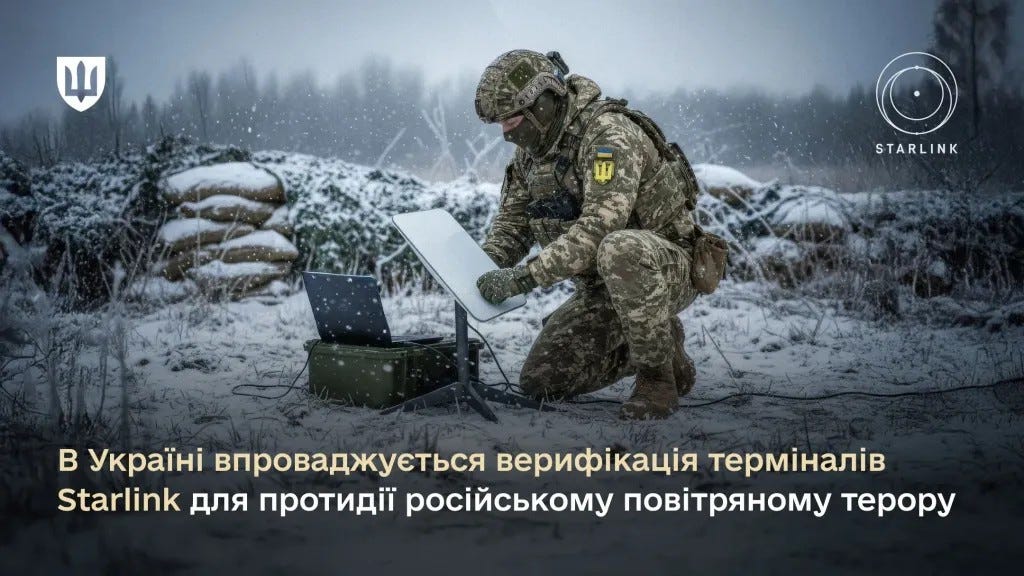
On January 30, around 08:00 in the morning, Ukrainian users began reporting radical restrictions on the movement speed of Starlink terminals. At speeds above 90 km/h, users received notifications about exceeding the speed limit for their tariff plan, and access to communication was disabled. After a significant reduction in speed or a stop, connectivity was restored. Quite quickly, discussions in social networks and various communities led to the conclusion that such restrictions were applied across the entire territory of Ukraine.
Unfortunately, no further official statements were made that day. In the Ukrainian information space, a certain information vacuum emerged on this issue, apart from discussions in some communities and on social media.
Obviously, the application of such restrictions came as an unexpected surprise not only to many Ukrainians but also to the aggressor. Ukraine is currently the world’s unequivocal leader in the quantity and quality of the daily-used fleet of various drones whose connectivity is provided by Starlink – UAVs, UAS, and robotic ground complexes. However, recent reports on the use of drones with Starlink connectivity by Russian invaders demonstrated systematic and large-scale use of fixed-wing UAVs by them, ranging from light reconnaissance to light and medium strike drones of various types.
According to currently available feedback in various communities and on social networks, Russian drone operators faced unexpected difficulties in carrying out their missions. Reliable public data on the number of UAV losses, whether Ukrainian or Russian, is currently unavailable. However, these speed limit restrictions on movement have undoubtedly led to significant limitations of capabilities on both sides.
This concerns not only drones but also the use of Starlink terminals on any mobile platforms while in motion. Cars, aircraft, helicopters, and any other moving vehicles. Therefore, wherever and for whatever purpose connectivity is needed during movement, such movement has become limited by a speed cap of approximately 90 km/h.
Medium and heavy UAVs are usually incapable of flying at such low speeds. Therefore, it is quite possible to speak of a certain success of these steps in reducing damage to civilian and military facilities in Ukraine from Russian UAVs. However, considering such a solution comfortable and acceptable for the Defense Forces of Ukraine would also be a mistake. The integration of Starlink satellite communications on their side is much deeper and more extensive.
On January 31, one of the advisers to the Minister of Defense published a statement in his personal Telegram channel, but without specifics. It contained only abstract explanations regarding the necessity of the steps taken and even apologies for the inconvenience caused. The situation accumulated details mainly through various communities and social networks and began appearing in the media. The information mostly consisted of users’ own observations of Starlink operation and their discussions.
On the morning of February 1, the Minister of Defense of Ukraine announced the next step – the start of implementing authorization of Starlink users and equipment, in order to ensure access to satellite communication services exclusively for authorized users. Of course, such a significant regulatory step requires a comprehensive approach and time. Therefore, beyond these statements, this day brought no new details.
On February 2, a new message from the Minister of Defense of Ukraine was announced regarding the implementation of a “whitelist” and authorization of all terminals. Already in the evening of the same day, the Ministry of Defense published instructions regarding the processes for registering Starlink terminals for military personnel, organizations, and individuals.
Therefore, let us take a closer look at what exactly has been implemented and for what purpose.
Implemented procedures for registration and authorization of Starlink terminals
As part of the first regulatory steps, the state introduced a set of basic procedures aimed at identifying and accounting for Starlink terminals used on the territory of Ukraine. These procedures are practical in nature and differ depending on the category of users – civilian users, organizations and companies, and military personnel.
Equipment identification
The basis of all procedures is the identification of a terminal by unique technical identifiers. For registration, the following are used:
UTID — mandatory terminal identifier;
KIT ID — optional;
Terminal serial number (Dish ID) — optional;
Starlink user account number — optional.
The presence of UTID is a sufficient condition to initiate the registration procedure. The absence of other identifiers does not block the process.
Procedures for individuals and sole proprietors
For citizens and individual entrepreneurs, an offline procedure through administrative service centers is provided.
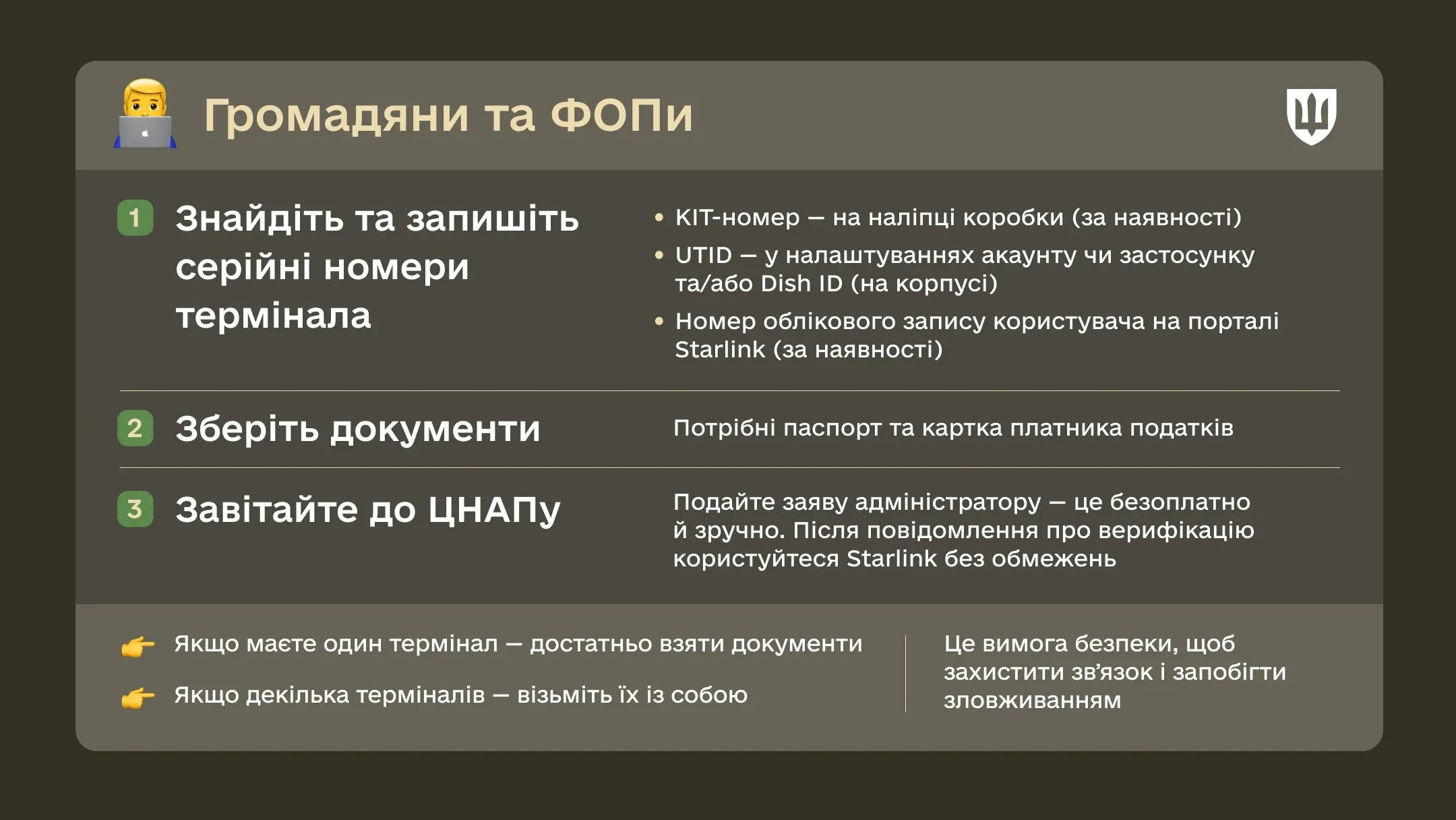
The procedure includes:
submission of terminal identifiers;
presentation of an identity document;
provision of the taxpayer identification number.
Registration is carried out free of charge.
Limits are established:
up to one terminal without physical presentation of the equipment;
up to three terminals with physical presentation.
Procedures for businesses and organizations
For legal entities, a digital procedure has been introduced via the “Diia” portal.
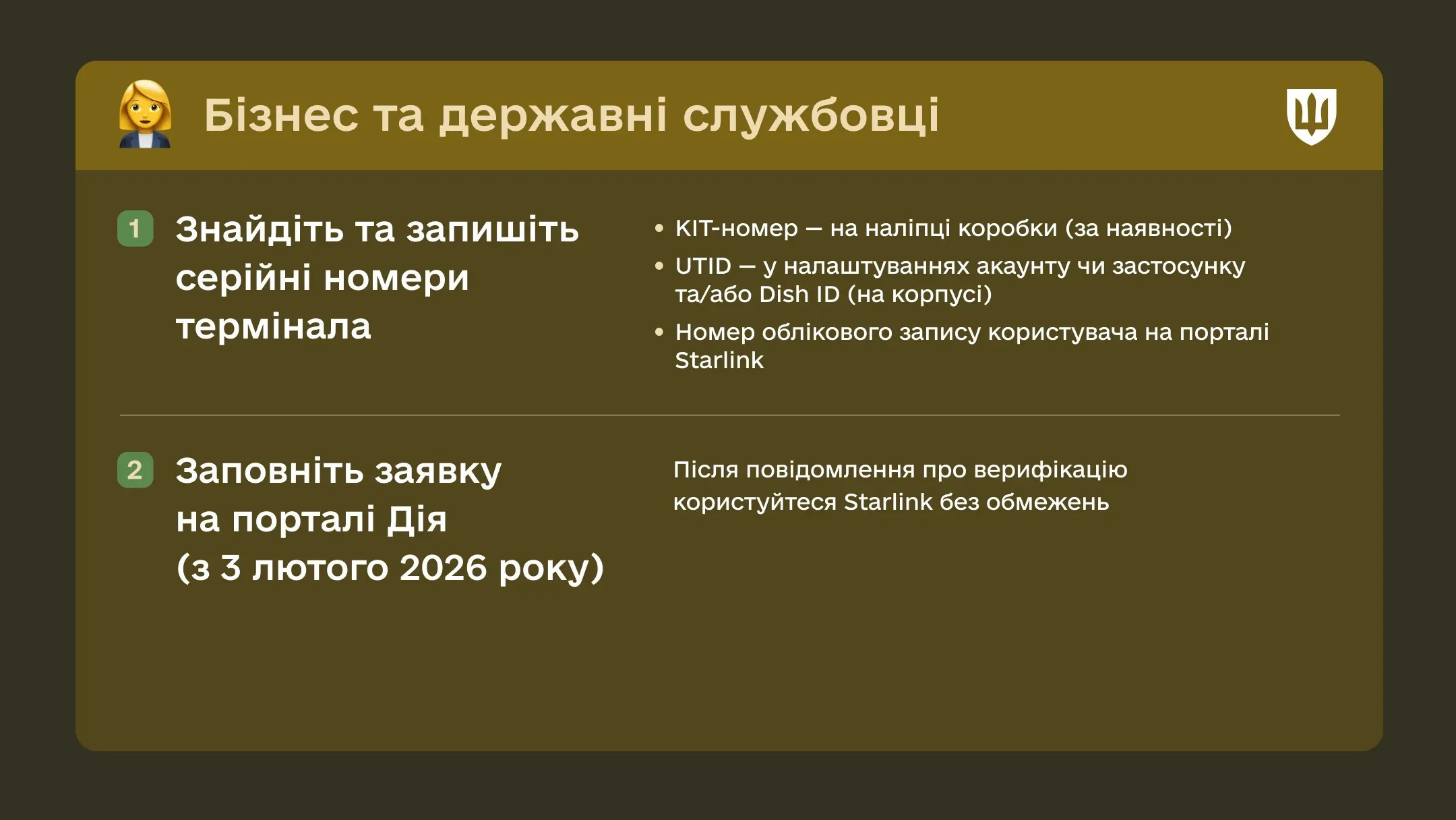
The procedure provides for:
authorization using a qualified electronic signature of the legal entity;
submission of terminal identifiers;
automatic transfer of data to the relevant state register.
For most organizations, a limit of up to ten terminals is established. For critically important enterprises, quantitative restrictions do not apply.
Procedures for the Defense Forces of Ukraine
For military users, a separate secure registration algorithm is applied, integrated into military digital systems.
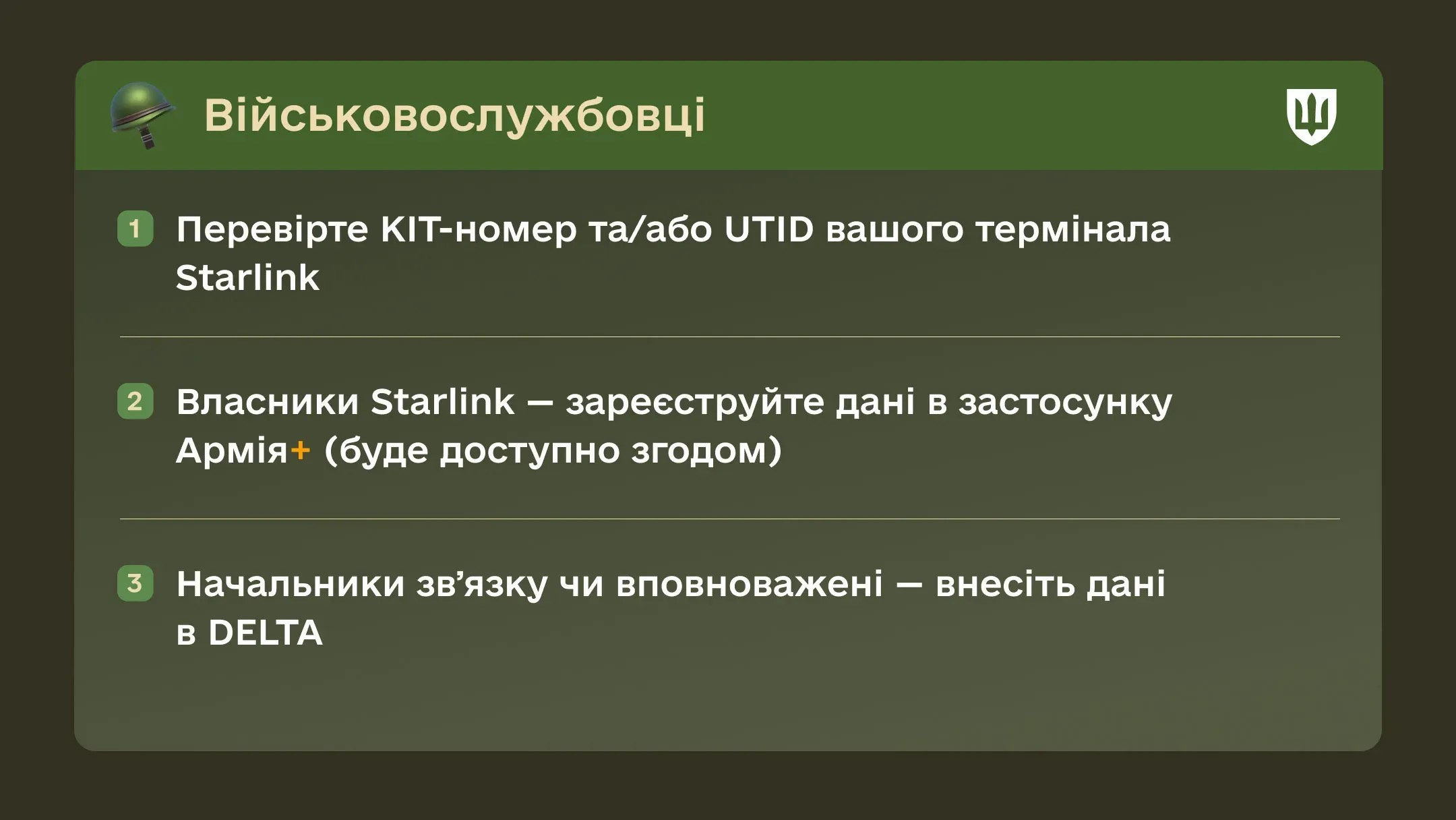
The procedure includes:
registration of data by the owner or user through the Army+ system;
entry and confirmation of data by authorized persons through the DELTA system.
Civilian registration channels are not used for this category of users. There are no quantitative limits on terminal registration.
General conditions for application of procedures
The introduced procedures do not require:
re-registration or changes to existing Starlink accounts;
activation of terminals that have not yet been put into operation;
switching to special tariff plans.
The procedures are aimed exclusively at accounting for and authorization of equipment and represent the initial stage of forming a regulatory system for Starlink satellite communications in Ukraine.
Analysis of the implemented Starlink regulatory framework
The restrictions and procedures introduced by Ukraine regarding the use of Starlink satellite communications should be considered not as a completed regulatory model, but as a forced initial reaction to the absence of any regulation previously.
In fact, until the end of January 2026, the use of Starlink on the territory of Ukraine was outside the national regulatory field, which was caused almost entirely by the absence of such a field itself. Users – both civilians and some organizations – directly entered into relations with SpaceX, paid for services to a foreign provider, and used the equipment without any formal authorization from the state.
Under such conditions, the state did not have:
a register of active terminals on its territory;
tools for identifying owners or users of the equipment;
mechanisms for distinguishing legitimate use from abuse;
levers for rapid response to security threats.
Forced technical restrictions as a first step
The movement speed restrictions on terminals introduced at the end of January likely became, in essence, a temporary preventive measure. They do not show signs of a well-thought-out long-term policy, but rather serve as a tool for rapid risk reduction in a situation where no other regulatory mechanisms existed.
These restrictions affected not only military use but also many civilian use cases, which confirmed their compromise and forced nature. This is what demonstrated the very necessity of further transition from crude technical restrictions to more precise control instruments.
Terminal authorization as the foundation for further solutions
The next logical step was the initiation of equipment authorization procedures and the implementation of the principle of “permitted terminals.” At this stage, the state effectively began creating a basic inventory of Starlink infrastructure on its territory.
It is important that the chosen model does not interfere with commercial relations between users and SpaceX and does not change existing accounts or tariffs. It is exclusively about identification and accounting of equipment, without which further regulation is fundamentally impossible.
This is the minimally necessary foundation:
for further implementation of access control policies;
for differentiation between civilian, commercial, and military use;
for abandoning universal technical restrictions such as speed limits.
Expected evolution of the regulatory model
Current steps should not be perceived as a final state. On the contrary, they create prerequisites for subsequent stages, which appear most likely.
A logical continuation may be:
implementation of user identification and responsibility policies (KYC approaches) that did not previously exist. SkyLinker recently wrote about the introduction of a similar approach in Poland;
transition from general technical restrictions to targeted access control, which can be built similarly to Israel’s permit-based system of Starlink availability in certain territories;
cancellation of crude speed limits for authorized and verified users;
formation of a transparent interaction model between the state and the SatCom service provider.
Thus, current decisions should be regarded as a forced initial stage in a situation where the regulatory field has to be built from scratch — already under conditions of war and active use of global commercial satellite infrastructure.
The support of paid subscribers of SkyLinker.io will allow us to share even better and even more independent analytics, interesting reviews, and produce training and educational materials. From an inexpensive subscription costing a few cups of coffee per month to a more significant “Patron” level — all of this is clearly and qualitatively converted into information and knowledge, primarily for the defenders of Ukraine.
All the most interesting things from the world of communication and space technologies are also available in the form of educational audio podcasts and video lectures both on the website and on the SkyLinker Youtube channel.
Blocking of unauthorized Starlink terminals in Ukraine has begun (updated)

On February 4, 2026, approximately at 20:00 Kyiv time, messages began to appear from Starlink users in Ukraine regarding the blocking of their accounts and/or connections. In particular, such messages appeared in the largest community in Ukraine, “Narodnyi Starlink”
How Serious Are the Real Problems with Starlink and Other Operators in Ukraine?

The issue of Starlink being used by Russian forces is, in reality, far broader and more complex than it is usually presented in typical media coverage. And it truly requires an urgent solution. Moreover, this is no longer a Starlink-only problem. Why? Let’s try to break it down—and at the same time understand what can be done about it.
The World’s Largest Terrorist State Continues to Purchase Starlink Equipment

The story of Russian use of Starlink has one defining feature: it never fully disappears. From time to time, new evidence emerges — new documents or new battlefield videos — repeatedly returning us to a simple fact: the Russian Federation has access to Starlink equipment and continues to use it.
Starlink 2025–2026: The Path to Global Hegemony

The year 2025 became the moment when Starlink finally established itself not merely as “the largest satellite constellation in the world”, but as a global communications infrastructure system. No longer a startup, not an experiment, not an “alternative for remote areas”
Starlink Onboard Terminals - Ukrainian Engineering Experience

Starlink satellite terminals are a high-tech system that is actively used in many mobile solutions, including all types of drones (UAV, USV, UGV). Maintaining stable communication while moving is quite a challenging task. Starlink developers not only incorporated the relevant functionality into their system during the development stage. They actually performed a gigantic amount of engineering work. But their high-tech result still has certain features and limitations.
Realities and Challenges of Using Starlink on Drones and Vehicles

In one of the previous publications, it was already mentioned how Starlink changed the paradigm of war, enabling the battlefield to generate massive data streams from any component or actor. But Starlink actually changed much more – the satellite communication industry itself became different. And above all, the