

On the night of 13–14 October 2026, drone operators on the Huliaipole axis noticed something odd: the link to the aircraft dropped out for 10–20 seconds every time it accelerated beyond 110–120 km/h. Nobody was jamming that link, and nobody had damaged the terminal. The service provider had simply changed the rules — without warning. Some missions had to be cancelled.
This is not a piece about who is to blame. We are not going to dig into the causes of the incident itself here. It is about the question that night put to everyone responsible for military communications: what keeps our command and control running when the best link suddenly gets worse?
A Good Link Does Not Equal Resilient Communications
Starlink has changed this war. It gave the front line mass-scale broadband connectivity, without which there would have been neither the drone era nor Delta in real time. But precisely because it is so good, far too much has quietly come to rest on it. It is easy to get used to a good thing… According to practical studies, if it is switched off, the ability of Ukraine’s Defence Forces to move data on the battlefield drops several-fold.
Imagine a city where all the power comes from a single excellent power station. While it runs, the lights are on everywhere. But power engineers know that a city’s resilience is defined not by the capacity of the station, but by a grid that can draw on several sources. Ukraine has learnt this lesson during the war, on its own energy system. Communications obey the same laws.
A Starlink link can disappear in three ways:
physically — the terminal is destroyed or damaged;
technically — by electronic warfare or a cyberattack;
organisationally — the terms of service change somewhere far away from the front.
In February 2026 we saw this scenario from the other side: once the terminal ‘whitelist’ was introduced, russian units lost their usual link — and the coordination of their assaults deteriorated noticeably. In October, the same mechanism, albeit in a milder form, touched us. The conclusion is symmetrical and sobering: an army that sits on a single link loses not its communications, but its ability to command.
The natural reaction to episodes like this is to look for a replacement. And there is plenty to look at. But no replacement will appear tomorrow, and none will reach the front at the scale required overnight.
What Are the Options?
If we map out the ways to reduce dependence on a single link, the picture looks roughly like this.
New global constellations. Amazon Leo promises initial service as early as this year, with around 400 of the more than 3,200 planned satellites already in orbit. Telesat Lightspeed is aiming for global service in the first quarter of 2028 and is separately building in military Ka-band. These are real links, but each one needs its own terminals, contracts and time to scale.
European and Ukrainian satellite projects and start-ups. There are plenty of them, and some look very promising. But they will not be delivering communications capability on the battlefield any time soon.
Eutelsat OneWeb — currently the only network with characteristics close to Starlink’s that is already available in Ukraine. But the ecosystem of terminal manufacturers is still not flexible enough, so on price, weight and capability its terminals mostly lag behind Starlink. Most importantly, network capacity is much smaller: the number of terminals it can serve is not yet comparable with Starlink.
Terrestrial links. LTE, fibre and radio relay are already in place in many areas, but each covers only its own patch.
An architecture that stitches together what is already there. The least visible path: not adding yet another ‘main’ link, but changing how a unit uses all the links it already has.
The first four paths widen the choice. The fifth answers a different question: what do we do with that choice once it arrives? Without it, every new link becomes yet another island. And a few years from now we will have not one dependency, but several running in parallel.
The Fifth Element: First the Network — Then the Way Out to the World
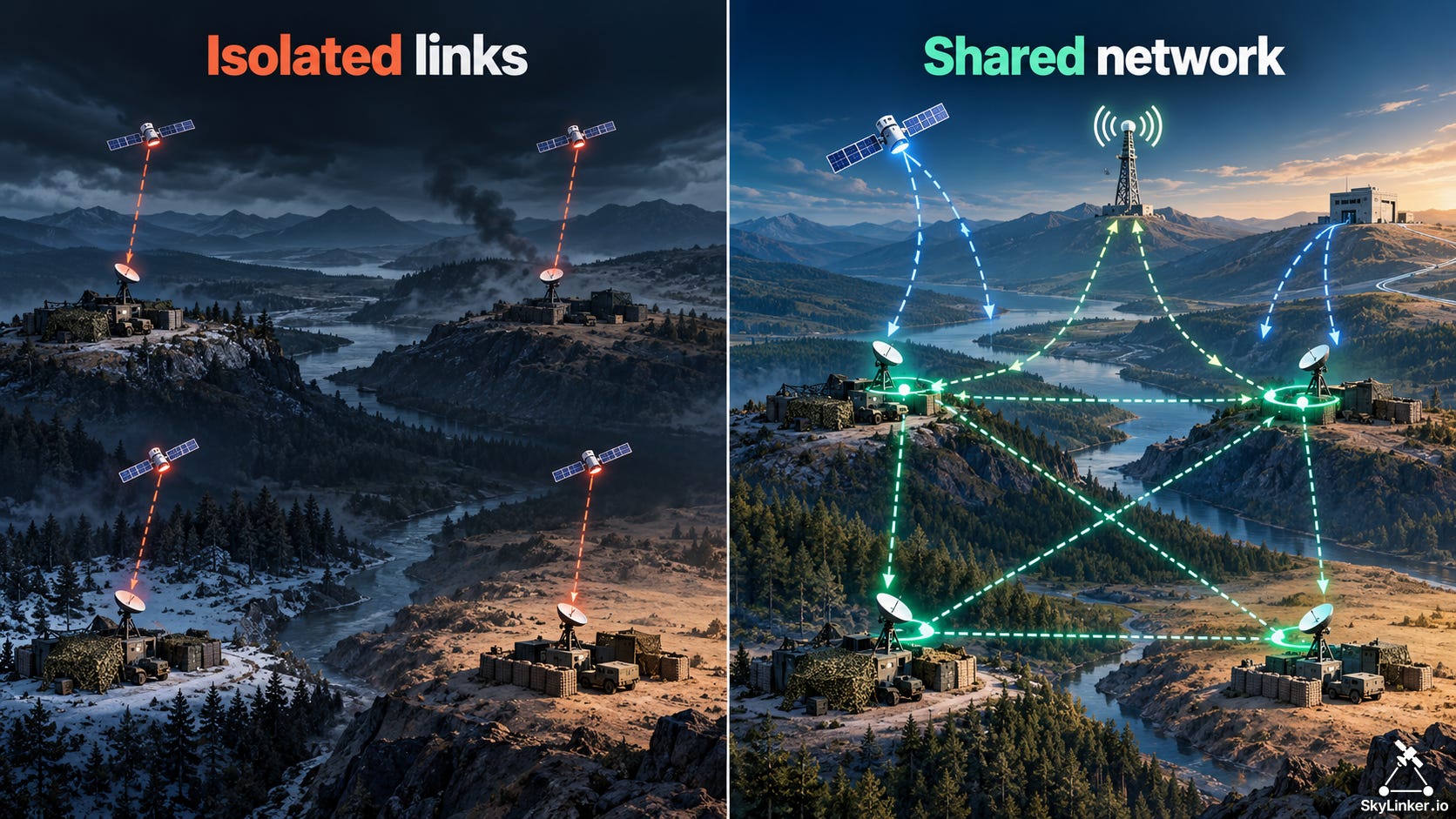
Today the typical picture looks like this: every position has its own terminal, and every terminal is an island of its own. Dozens of independent links, and none of them backs up its neighbour. Lose the link — and the position goes blind, even if a perfectly serviceable dish belonging to the neighbours stands a hundred metres away.
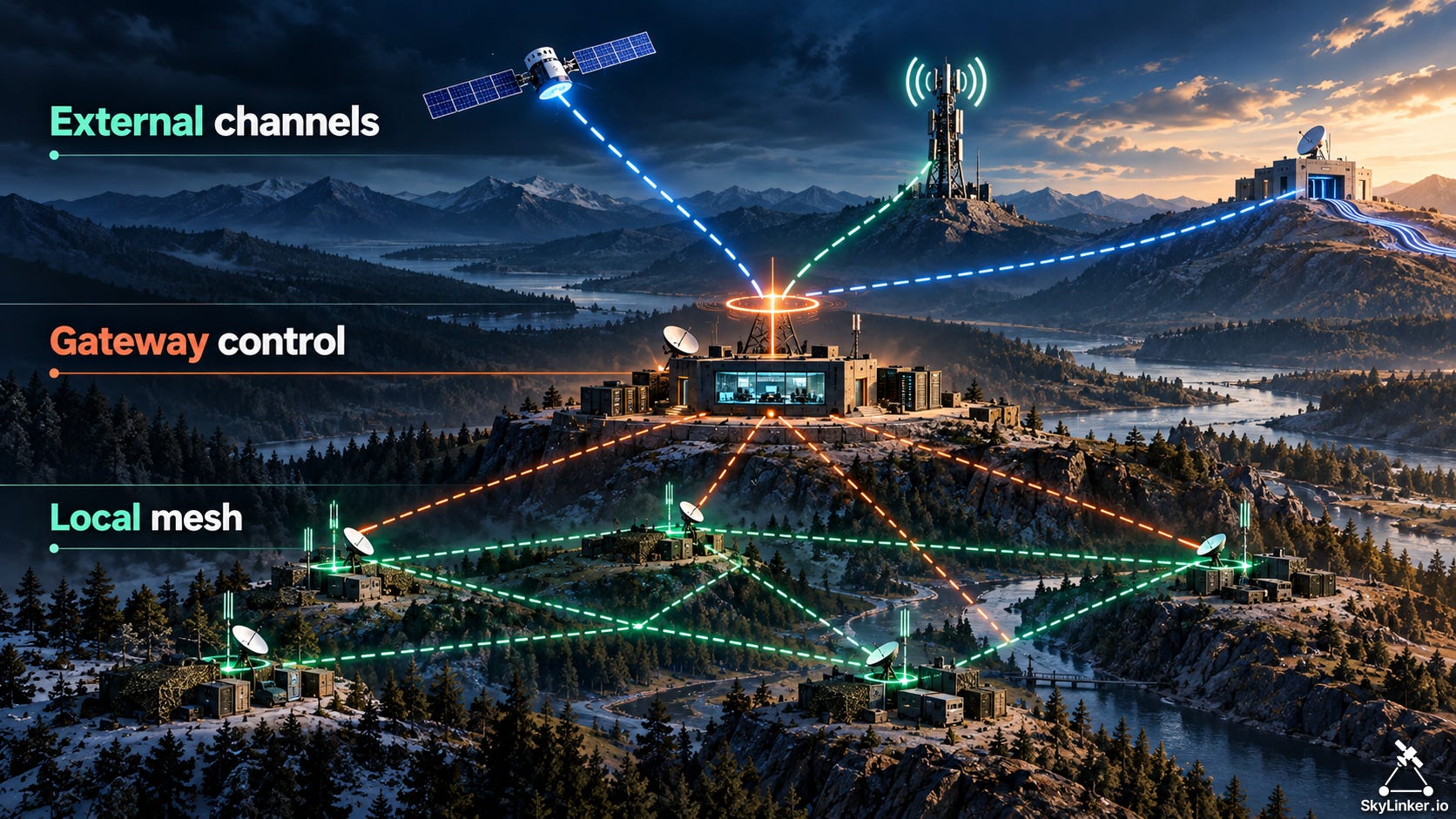
The approach known as MANET (mobile ad hoc networking) proposes turning this logic on its head. First, a network of the entire unit is built, and only then does it reach the outside world through several shared gateways. Every node in such a network is at once a user, a router and a relay. The network is self-forming and self-healing: it rebuilds its routes on its own when a node drops out. The idea is not new: it has been developed for the military for decades, and today there are several mature implementations on the market. We cover this in detail in our deep dive ‘MANET: When the Network Itself Is on the Move’.
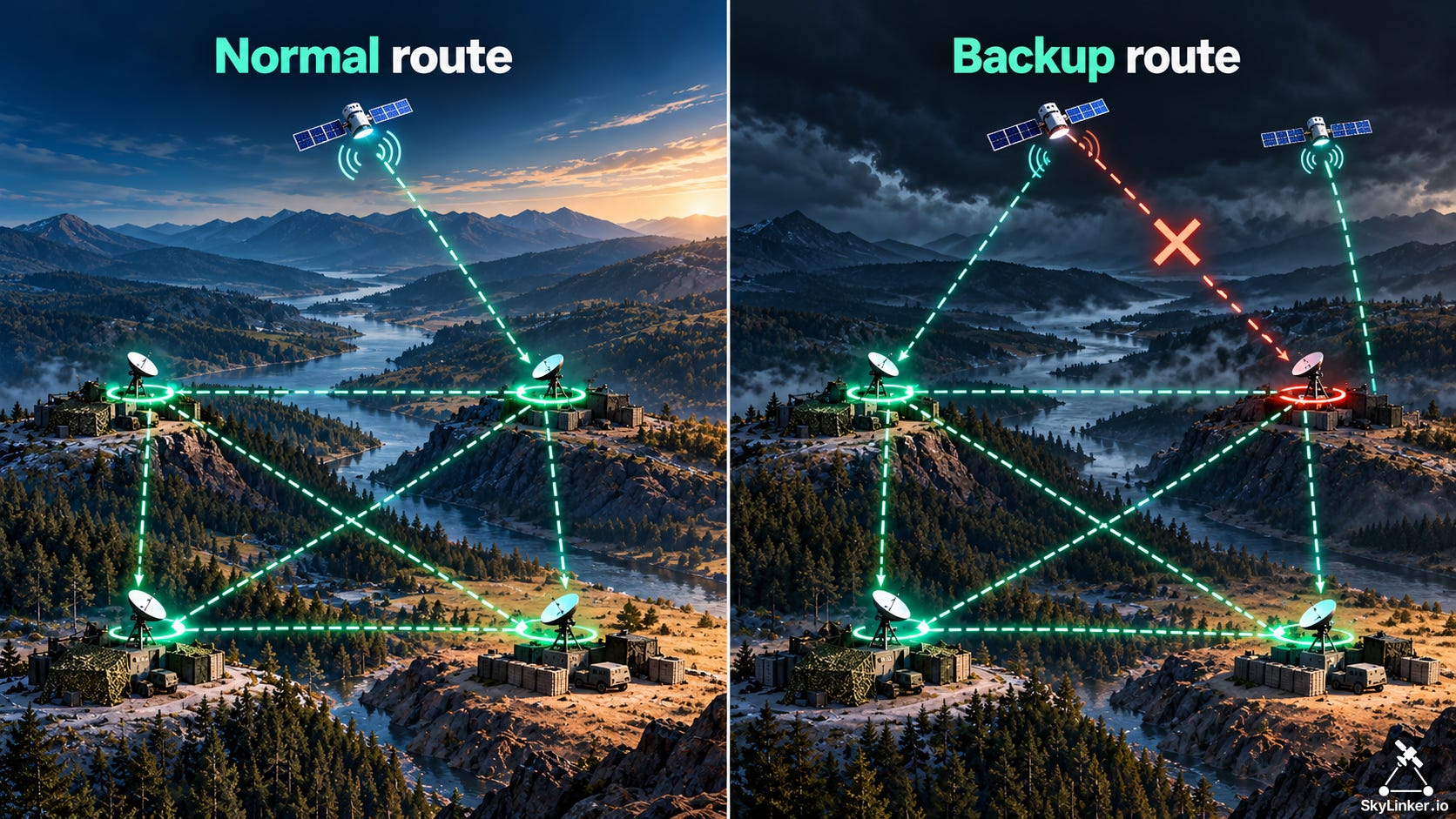
What matters most is how such a network treats external links. Take Persistent Systems’ Wave Relay® MANET as an example — one of the most mature MANET implementations, and one that has already been used in Ukraine. Its network layer is transport-agnostic: it does not care where a packet came from. Starlink, and later Amazon Leo or Lightspeed, a geostationary satellite, an LTE modem on a vehicle, fibre to headquarters — to it these are simply different doors out of the same house. The Cloud Relay™ software hub keeps several of these doors open at once, constantly checks which of them are widest right now, and moves the traffic over by itself when some of them close. The military calls this PACE — Primary, Alternate, Contingency, Emergency. The only difference is that here the plan is executed by the network, not by the duty signaller at three in the morning.
One more detail that is often overlooked: local traffic stays local. If the neighbouring platoon needs the video from your drone, it travels directly across the network rather than up to orbit and back. Satellite capacity is spent only on what genuinely has to leave the battlefield. That is why even a narrow backup link turns out to be surprisingly useful in this architecture: it carries only what is critical.
In a single sentence: every link becomes shared, and none is the only one.
What It Means for the Position, the Brigade and the State
The same idea looks different depending on the altitude from which you view it.
At the position: ‘The terminal is destroyed — and we are still on comms.’ The position lives in the network, not on its own dish. If its own link is gone, traffic flows through neighbouring nodes to another gateway. What is more, the terminal itself can now be sited further back, where it is easier to protect, while the mesh carries connectivity to the forward edge. Dish to the rear, comms to the position.
At brigade HQ: ‘A link went down — and the brigade didn’t notice.’ All terminals, modems and lines are brought together into one managed network with a single map. The brigade signals officer can see which path the traffic is taking right now and what will happen if that path disappears. A unit that comes under a different command brings its nodes and gateways into the same network without rebuilding it.
At state level: ‘No single provider is a point of failure for the front.’ The risk of concentration on one supplier cannot be removed by contracts — only by architecture. Amazon Leo, Lightspeed, and future European and Ukrainian solutions will become useful on the day they arrive, not after a year of integration: all it takes is one more gateway. The equipment belongs to the armed forces, the encryption keys stay with the owner, and the point where the network is stitched together can sit on the owner’s own server.
Honestly About the Limits — and About What Matters Most
MANET does not replace a satellite or a terrestrial link. A mesh network gives a unit its ‘digital neighbourhood’; a satellite gives it the ‘horizon’. A long-range drone over enemy territory still needs its own link on board. And as long as a unit has only one type of external link, even the smartest network will have nothing to switch between.
But that is precisely why a network capable of stitching links together must arrive before the new links themselves. Then every new terminal, modem or satellite service immediately adds resilience to the whole unit, instead of becoming yet another island.
There are many ways to reduce dependence on Starlink, and none of them should be dismissed: new constellations, home-grown developments, terrestrial networks — all of it is needed. But most of them demand time, money and new infrastructure. The path described here is one of the most accessible, because it works with what is already there: the same terminals, modems and lines. And it is also one of the most underrated: it is easy to mistake it for ‘just another radio’, when in fact it is about architecture.
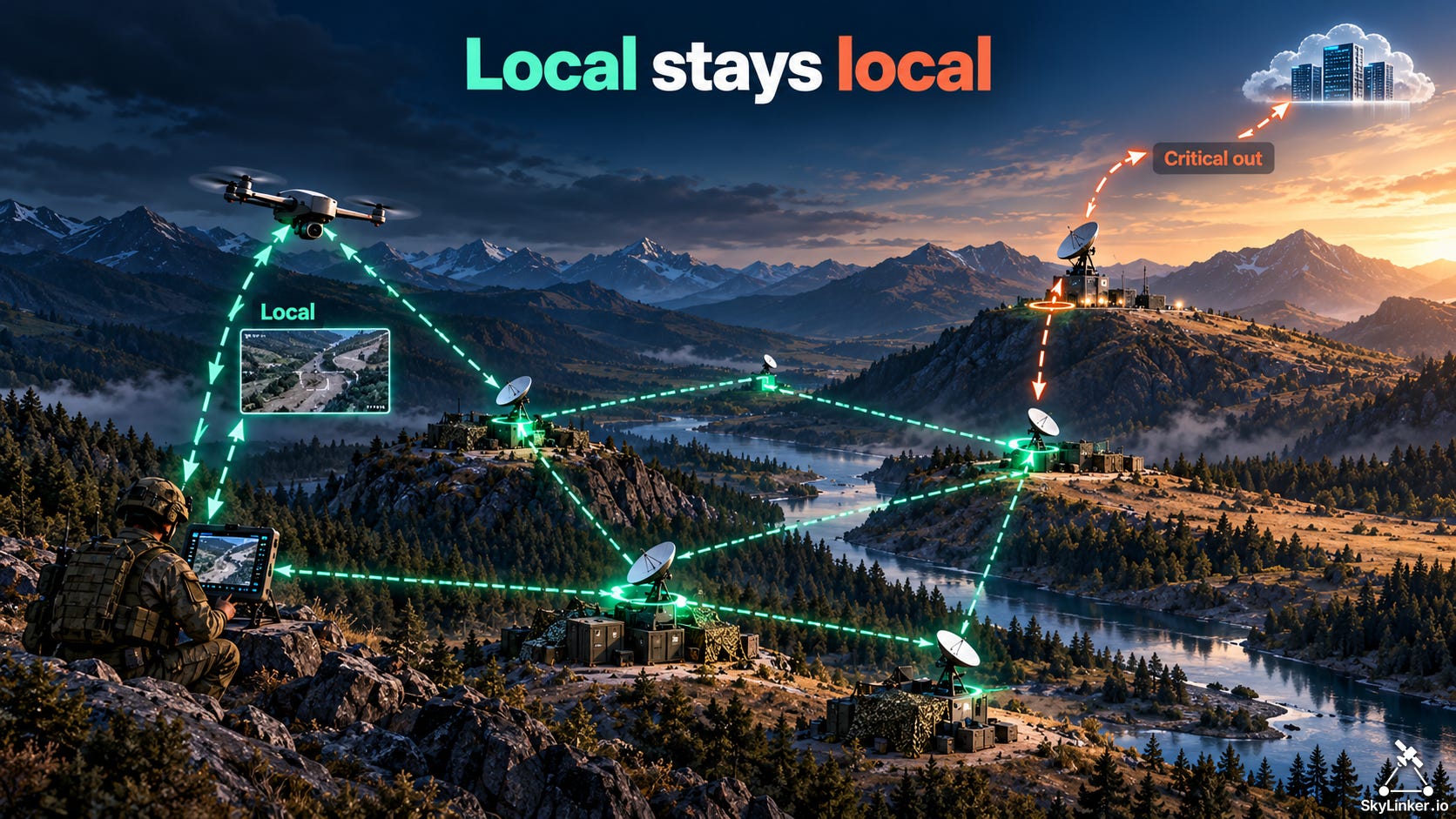
Resilience does not come in the box with a terminal. It is built — by a network in which every link is shared and none is the only one.
The support of paid subscribers of SkyLinker.io will allow us to share even better and even more independent analytics, interesting reviews, and produce training and educational materials. From an inexpensive subscription costing a few cups of coffee per month to a more significant “Patron” level — all of this is clearly and qualitatively converted into information and knowledge, primarily for the defenders of Ukraine.
All the most interesting things from the world of communication and space technologies are also available in the form of educational audio podcasts and video lectures both on the website and on the SkyLinker Youtube channel.
Communications: The Nervous System of a Fighting Force

Picture the strongest organism imaginable: powerful muscles, endurance, reflexes, will. Yet whether it can fight at all comes down to one thing — its nervous system. The nervous system adds no strength of its own. It makes strength controllable. The same holds true for the defence of Ukraine: communications are not a service or an accessory that people …
MANET: When the Network Itself Is on the Move

MANET is often reduced to the notion of “just another mesh network.” But in reality, MANET is something much bigger — a network that can move, reconfigure, and survive together with its users. In this article, we will look at how MANET evolved from early packet radio networks into modern digital infrastructure for vehicles, drones, sensors, and units; w…
EW vs. Starlink: What Actually Works?

For the fifth year, we have been observing the battlefield changes brought about by LEO SatCom systems, such as Starlink. The practical use of Starlink by the Ukrainian Defense Forces has not only proven the resilience of such communications but also laid the groundwork for the dawn of the “Drone Warfare Era.”
What is Direct-to-Cell from Starlink and how does it work

Just a few years ago, the idea of calling or sending a message from a remote mountain valley directly via satellite using a regular smartphone seemed like science fiction. Today, these are the first field tests. SpaceX with Starlink, along with mobile operators, show that a phone can “reach” orbit
Starlink Onboard Terminals - Ukrainian Engineering Experience

Starlink satellite terminals are a high-tech system that is actively used in many mobile solutions, including all types of drones (UAV, USV, UGV). Maintaining stable communication while moving is quite a challenging task. Starlink developers not only incorporated the relevant functionality into their system during the development stage. They actually performed a gigantic amount of engineering work. But their high-tech result still has certain features and limitations.