

For the fifth year, we have been observing the battlefield changes brought about by LEO SatCom systems, such as Starlink. The practical use of Starlink by the Ukrainian Defense Forces has not only proven the resilience of such communications but also laid the groundwork for the dawn of the “Drone Warfare Era.”
In this publication, we will dive deeper into a crucial aspect: how effective can modern Electronic Warfare (EW) systems be in suppressing this type of communication?
The time has not yet come for the public classification and detailing of the variety of ECM/EW (Electronic Countermeasures/Electronic Warfare) systems used to counter Starlink; under the current conditions of war, such information is too sensitive for the public domain. Eventually, this information will make its way into the public sphere to replace the prevailing propaganda paradigms and fabricated technical specifications currently dominating it.
However, we will attempt to understand the basic operational principles of such systems and superficially evaluate the effectiveness of what the aggressor’s forces are currently using in Ukraine in this article.
From the moment Starlink was first used in Ukraine, Russian forces faced a radical mismatch between their plans and reality. The modern, high-quality, and high-speed Starlink satellite communications could not be suppressed by any ECM/EW asset the enemy possessed at the beginning of the invasion.
Furthermore, blocking access to Starlink in the occupied Ukrainian territories tragically impacted the combat effectiveness of the occupying forces. The enemy has still not been able to adequately compensate for the loss of this communication capability.
Naturally, developing new ECM/EW systems capable of overcoming Starlink’s resilience became a high-priority task for the enemy’s scientists and engineers. The enemy’s initial attempts in 2022-2023 yielded no significant results. Attempts to “jam” the reception channels of Starlink satellite terminals occasionally produced nothing more than an exclusively minor, locally restricted effect.
We saw fully-fledged systems developed specifically to counter Starlink on the battlefield in 2024—these were essentially prototypes of the “Peresvet” systems. There were, of course, others...
Since then, the enemy has not stopped developing, improving, and scaling such systems. This is especially true regarding countermeasures against Ukrainian medium-strike and deep-strike assets.
Currently, both in the media and in backstage conversations, we frequently hear that “the enemy has learned to shut down Starlink,” alongside various complaints from drone pilots. Is this really the case? Have effective LEO SatCom jamming systems been found?
How Does Starlink Work?
To understand the core issue, we must examine the operational principles of Starlink satellite communications and its components.
As with any satellite communication network, we have three main system components: satellites, user terminals, and ground infrastructure.
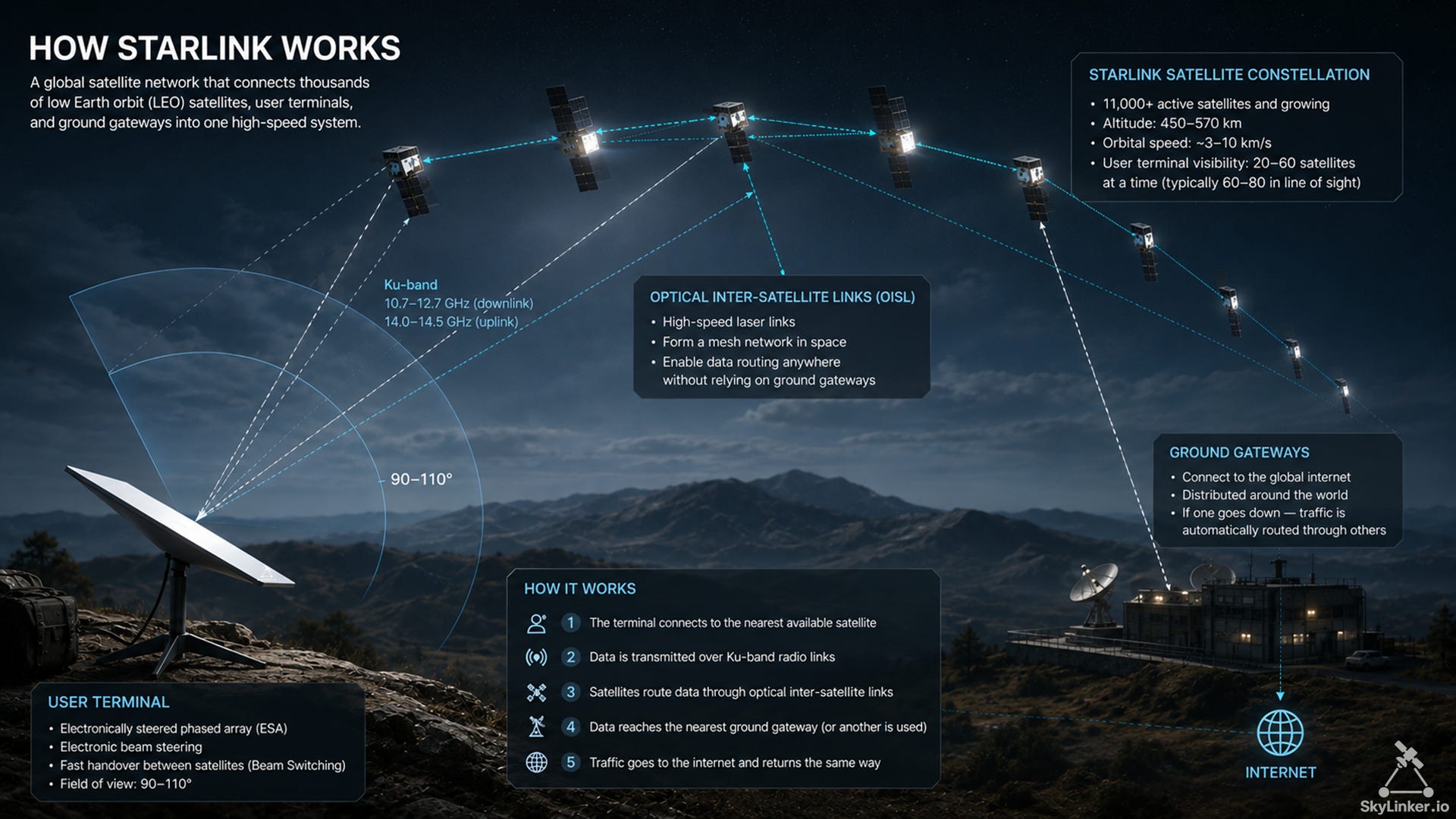
The Starlink low Earth orbit (LEO) constellation currently consists of over 11,000 active modern satellites at altitudes of 450-570 km. This means that any Starlink terminal in Ukraine has the geometric capability to establish a connection with 60 to 80 satellites at any given moment.
Let’s also recall that Starlink satellites fly over us at a high angular velocity. Therefore, if we wanted to track such a satellite with a telescope or a highly directional parabolic antenna, we would need to use a precise and fast servo drive. The transit of these satellites through a ground-based observation zone is very fast, taking between 3 and 10 minutes.
Because the Starlink satellite terminal utilizes an Active Electronically Scanned Array (AESA), it can interact with any satellite within its line of sight. The terminal’s field of view is essentially a cone with a 90-110 degree angle. Meaning, it’s not the entire sky.
Thus, depending on the terminal’s orientation, roughly 20 to 60 satellites are always physically accessible to it. Thanks to Beam Switching technology, a Starlink terminal is always ready and actively finding the next satellite to switch to in the event of losing connection with the current one.
The vast majority of Starlink satellites are equipped with Optical Intersatellite Links (OISL). In other words, almost all satellites form a sort of mesh network. This allows them to operate independently of the availability of ground infrastructure within a satellite’s radio range.
This means data can be transmitted between the terminal and ground infrastructure through a chain of these intersatellite links. In the event of losing a specific ground gateway—one of many—the Starlink network will simply reroute the traffic to another.
What Can EW Do Here?
From the above description, it is clear that attacking the Starlink ground infrastructure with EW systems makes no sense and is practically impossible. So, let’s figure out what actually can be attacked here.
Communication between the terminal and the satellites occurs via radio waves in the Ku-band:
Downlink (downward, from satellite to terminal): 10.7 - 12.7 GHz (usually divided into several software-defined channels of ~250 MHz).
Uplink (upward, from terminal to satellite): 14.0 - 14.5 GHz (500 MHz band, channels of ~60 - 62.5 MHz).
GNSS
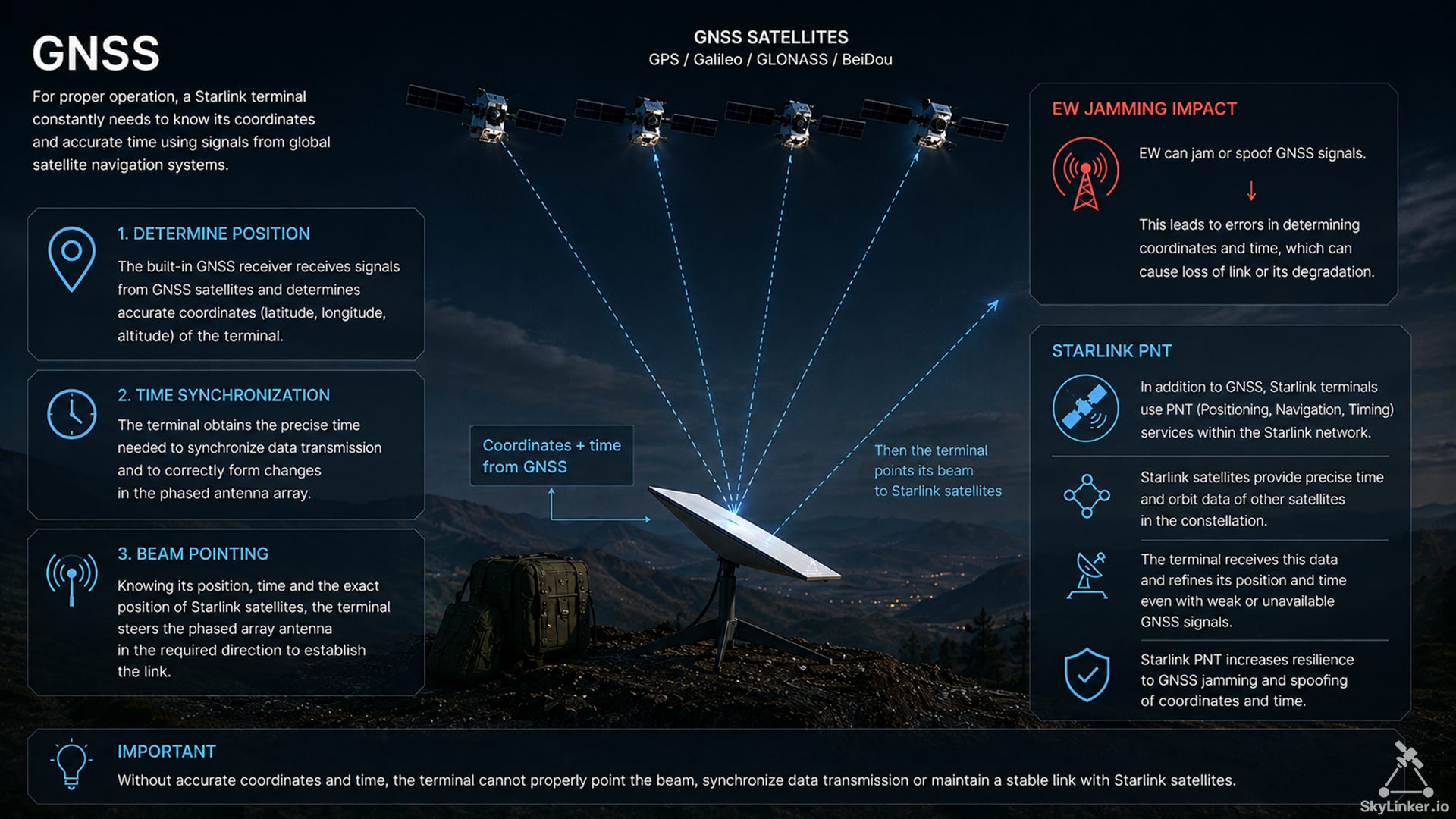
For the precise aiming of the Starlink terminal’s beam, it always needs to know its own coordinates and the exact position of the satellites. A kind of “space trigonometry.” An integrated GNSS receiver is usually used for this purpose.
This is why unmodified Starlink terminals are vulnerable to ECM/EW systems that disrupt GNSS operations. However, after SpaceX “polished” its own Starlink PNT (Positioning, Navigation, and Timing) service, Starlink terminals became less dependent on GNSS. The new Starlink V5 terminal was recently introduced as a revision without an onboard GNSS receiver altogether. At the same time, a V5 revision with an onboard GNSS terminal is also expected.
To be fair, Elon Musk’s company restricted users’ ability to utilize Starlink PNT in May 2026. But the Starlink PNT technology itself hasn’t gone anywhere; it continues to run “under the hood” of the terminals.
Satellites
The ability to “jam” satellite receivers on the frequencies used by terminals to transmit data has been known for a long time and is actively utilized by corresponding ECM/EW systems.
But in the case of Starlink, or any other LEO constellation, the task is significantly more complex:
Dozens of satellites must be jammed simultaneously (and their numbers are growing weekly).
High angular velocity requires extremely precise targeting for each satellite.
Jamming in the Ku-band requires highly expensive solutions and massive amounts of energy.
Meaning, effectively suppressing Starlink communications in a specific location (an H3 Level 5 cell) requires simultaneously and effectively jamming virtually all those fast-moving satellites available to the terminals in that area. As a reminder, today alone that is 20-80 satellites...
Executing such a task demands an incredibly complex and expensive system capable of delivering about 95 dBW EIRP—which is equivalent to 3.16 GW of effective radiated power directed at each satellite.
Due to the antenna being precisely pointed at the satellite, actual power consumption would naturally be much lower—but we could still be talking about units or tens of megawatts per single channel. Now, multiply this by the dozens of satellites that need to be tracked simultaneously with separate beams. Here, the total power consumption rapidly crosses into hundreds of megawatts, entering the gigawatt class. In other words, a large power plant might not generate enough power for such a task.
Naturally, practically realizing this scenario is impossible. Therefore, the enemy has chosen a different path: creating interference that does not completely jam the satellite’s data reception but only introduces certain pulse interference.
This approach allowed them to fit within a much smaller energy budget, but at the cost of reduced jamming efficiency. Essentially, the enemy produces systems with power consumption up to tens of kW that are only capable of partially jamming the communication from the terminal to the satellite.
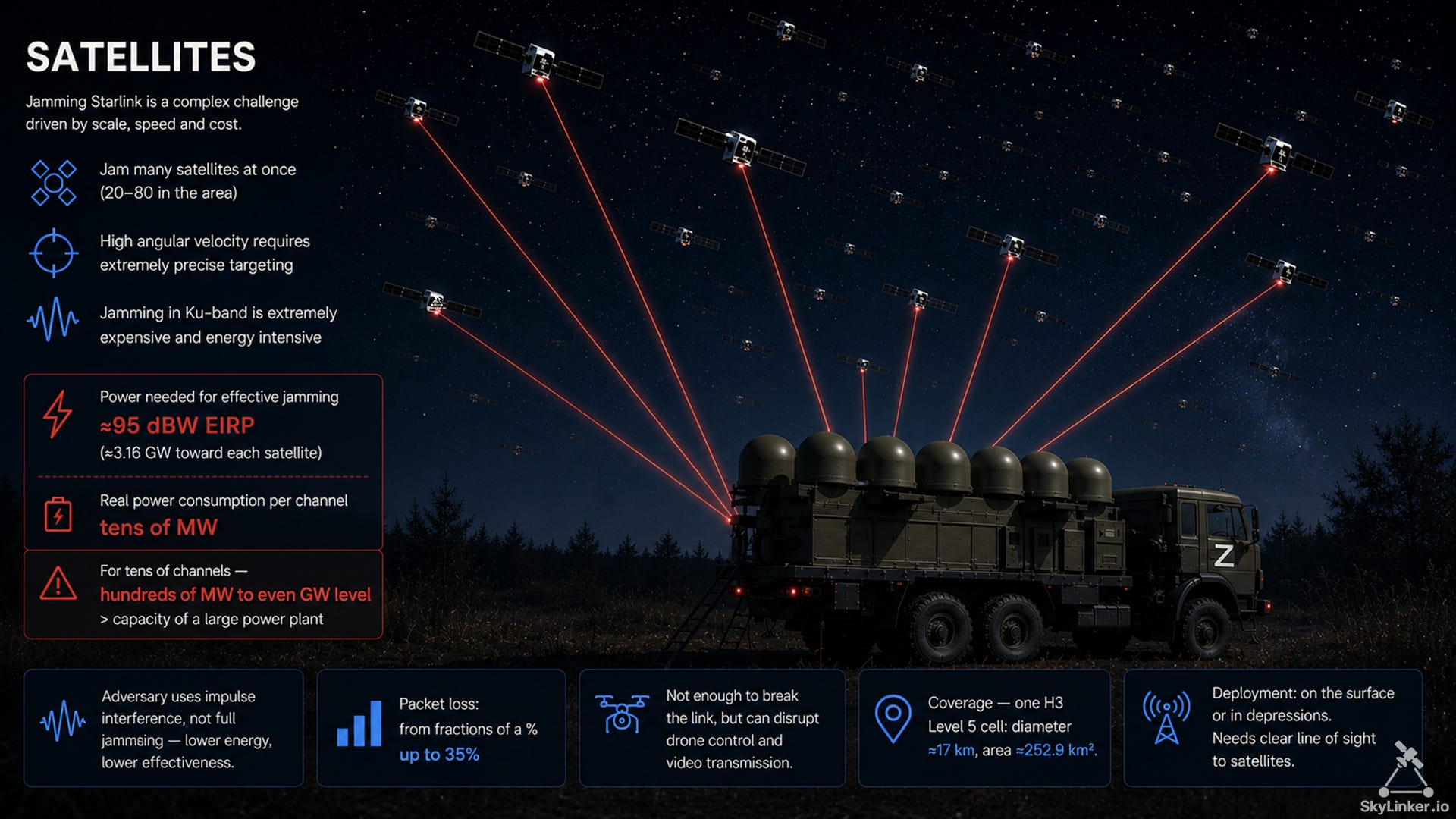
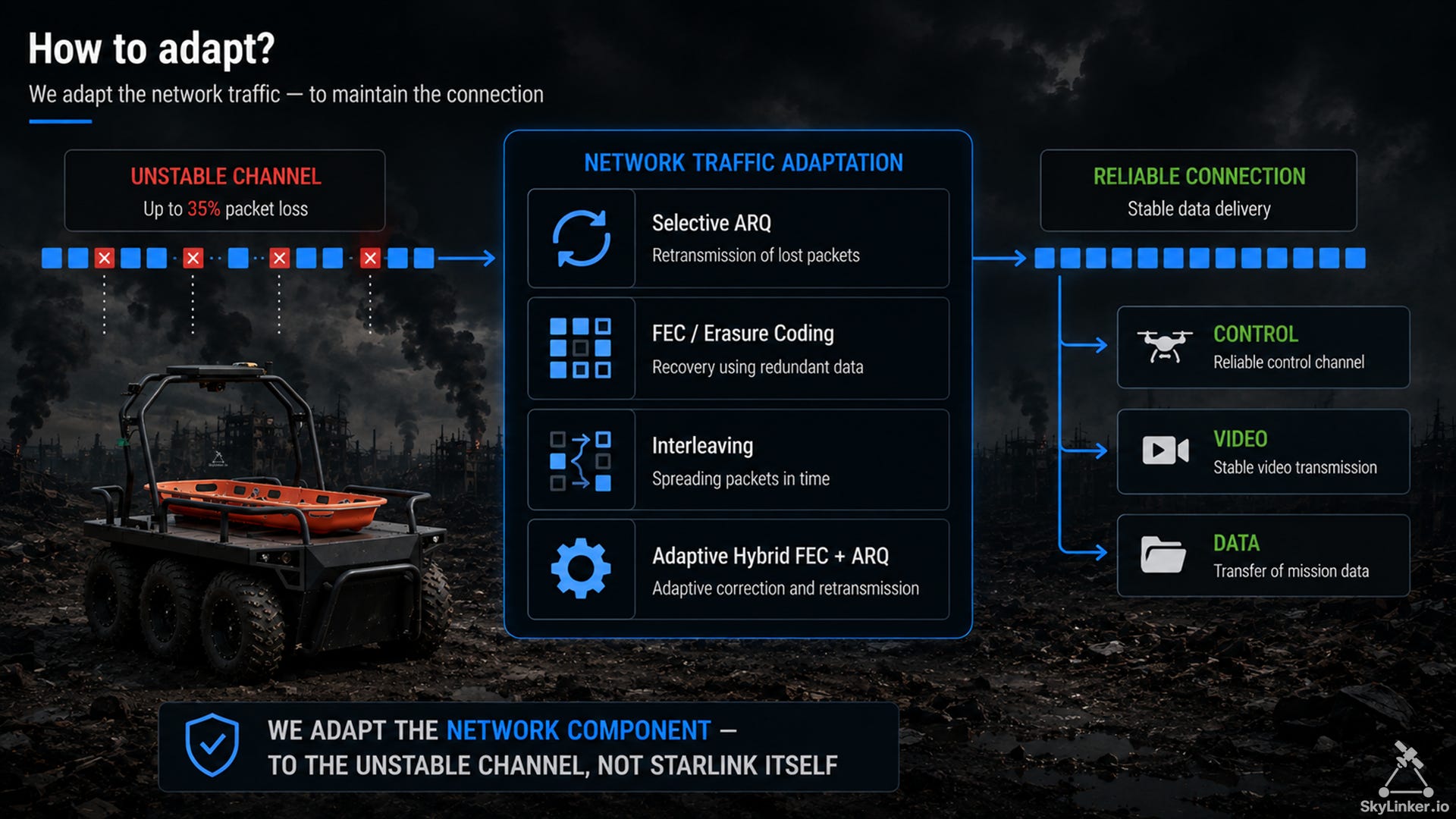
Such jamming typically results in a loss ranging from fractions of a percent up to 35% of all data packets (according to our observations) sent from a Starlink terminal operating within the coverage area of such an ECM/EW system. This is insufficient for a complete communications blackout. However, it is entirely sufficient to disrupt drone control or video data streaming if the system is not adapted to such conditions.
These systems can be deployed directly on the ground surface or in depressions—they only need an unobstructed line of sight specifically to the satellites. Accordingly, power supply and camouflage are the primary limiting factors here, but they are moderately easy to resolve.
The operational effectiveness of these ECM/EW systems is limited by location—a hexagonal H3 Resolution (Level) 5 cell, equivalent to a spot with a nominal diameter of 17 km and an area of 252.9 km². Impact on adjacent locations is possible, but due to different emission angles relative to the satellite antennas, the effectiveness is significantly lower.
Terminals
Starlink satellite terminals receive data from low Earth orbit satellites, whose signals are orders of magnitude stronger than signals from GNSS (MEO) or geostationary (GEO) satellites. Therefore, these terminals are relatively invulnerable to ECM/EW systems.
However, if relatively powerful emitters are positioned at significant altitudes or in close proximity, Starlink terminals can certainly experience interference and the loss of a certain percentage of transmitted data.
Thus, to cover specific locations and assets, the enemy tries to place emitter antennas as high as possible—on roofs, towers, topographic high points, etc. The limiting factor here is the capability for power supply and camouflage.
It is also worth noting the enemy’s active work on low-power ECM/EW systems targeting Starlink. Recently, more and more of such tactical-level assets have been appearing. The principle of operation remains the same: introducing pulse interference into the data reception by Starlink terminals.
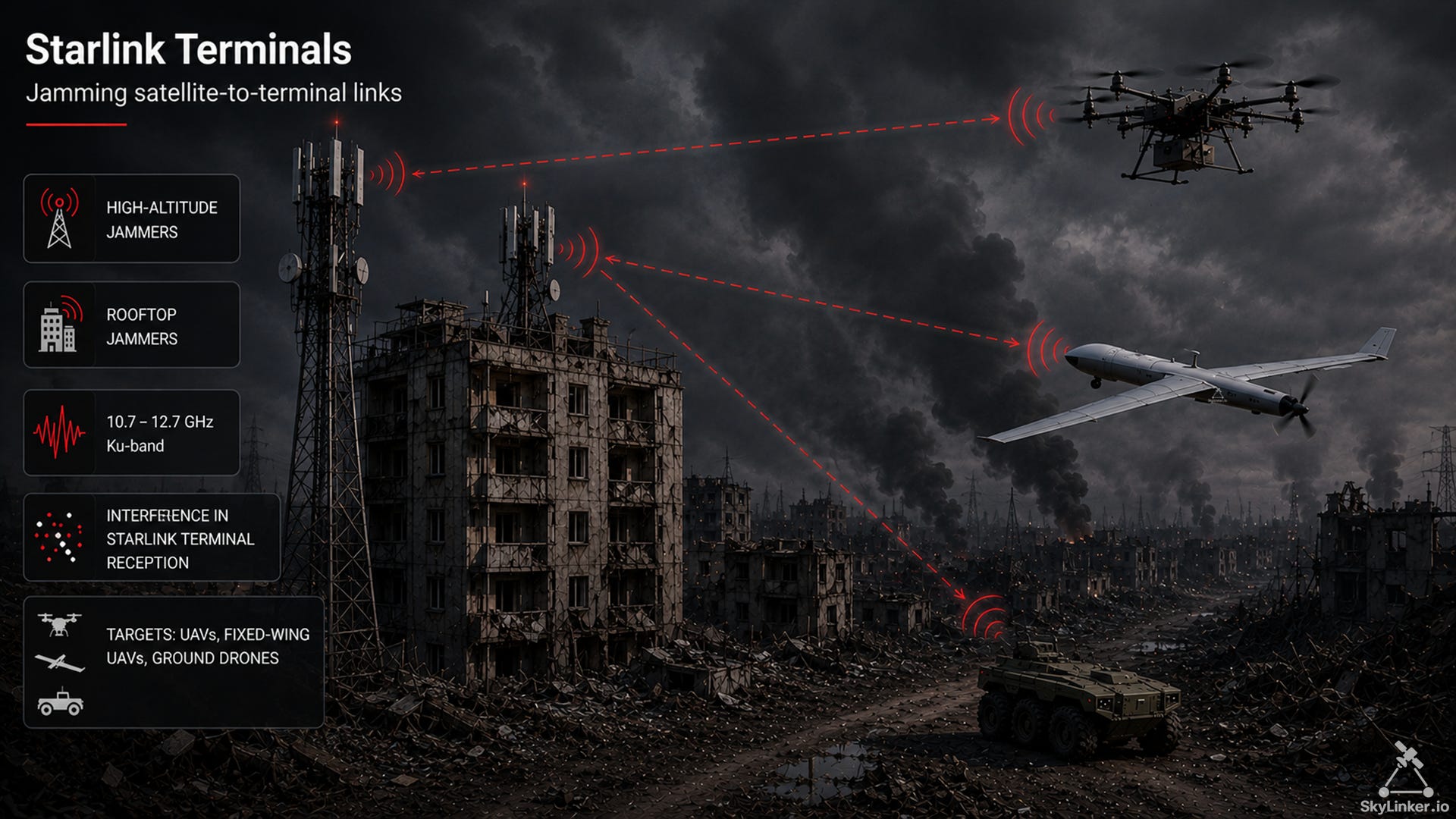
The effectiveness of these assets is relatively low. However, it can lead to a loss of control over reconnaissance and strike assets that are unadapted to such conditions. This primarily concerns drones, whether aerial, ground-based, or maritime. That is, the effectiveness of such assets today depends more often on the element of surprise rather than systematic use.
How to Adapt?
All the aforementioned ECM/EW assets share one common trait: they are largely ineffective.
Yes, this sounds strange. Especially to those who have felt their impact in the form of lost drone control, etc. But let’s look closer...
The energy budget, significant cost, and complexity of such ECM/EW systems, alongside other factors, have led to a simple result: their maximum effectiveness is only a PARTIAL packet loss in communication between the Starlink terminal and the satellites.
Yes, if your system is not adapted to partial packet loss, you will get an entirely negative result—video streams drop out, control is lost, etc. Meaning, the outcome appears “effective enough”... Until you check the Starlink telemetry and see that all this time your terminal has remained connected to the satellite.
In other words, the problem you are observing is not a problem of the Starlink terminal losing its connection to the satellite network. It is a problem specifically with the delivery of your data over the satellite communication channel.
If, for example, the drone’s onboard system utilizes adequate network technologies in its communications that allow it to operate under high data packet loss conditions, you might not even notice the impact of these ECM/EW systems. Or you might only experience a certain drop in channel bandwidth.
All that is required to achieve this is to utilize already existing solutions for guaranteed traffic delivery. That is, to implement the necessary systems and algorithms on already existing equipment.
The corresponding technologies did not appear “just today,” or even “yesterday”... Network solutions utilizing principles of redundancy, correction, and data retransmission are all rather “good old” technologies for operating in unstable connection environments.
For professionals, we recommend paying attention to:
Selective ARQ – the selective retransmission of only the packets that were lost.
FEC / Erasure Coding – the transmission of additional control data that allows for the recovery of a portion of lost packets without retransmission. This includes Reed-Solomon, Raptor/RaptorQ, RLNC, and other similar algorithms.
Interleaving – separating packets in time so that a series of consecutive losses is distributed among different FEC blocks and does not exceed their recovery capabilities.
Adaptive Hybrid FEC + ARQ – a combination of correction and retransmission, where the volume of redundant data automatically adjusts depending on the current level of channel loss.
Naturally, providing alternative, supplemental communication channels is always a good solution too. But it is not always available...
Of course, such resilience is not free; you have to pay for it with a portion of the bandwidth, additional traffic, and, depending on the solution, a certain increase in latency.
Conclusions
Yes, the enemy is intensively saturating the battlefield with EW systems to suppress Starlink. The effectiveness of these assets appears significant only at first glance. In reality, their technical effectiveness is much lower if communications technologies are adapted at the network level.
Unfortunately, there are no simple, magic settings that will allow a Starlink terminal to ignore the mentioned ECM/EW systems. However, if you treat Starlink as just one of the data transmission and reception channels, utilizing the most accessible network-level technological solutions will allow you—if not to completely eliminate the vulnerability—to minimize it to an acceptable level.
Essentially, your task is simply to teach your system to operate stably even at a nominal 35% packet loss, which such EW systems can generate. This neutralizes the impact on your reconnaissance and strike assets—if not entirely, then to a significant degree.
Consequently, if your communications system is adapted to the corresponding conditions, the effectiveness of such ECM/EW systems against Starlink rapidly approaches zero. At the same time, these systems themselves remain highly expensive, complex, and technologically demanding products, upon which the enemy has expended considerable resources for development and deployment.
Expended without achieving the goal...
Adapting your systems does not mean adapting Starlink. It is the adaptation of your existing network component to unstable communication channels.
We should also not underestimate the enemy; there is a probability that the effectiveness of such ECM/EW systems will increase over time. However, alternative means of satellite communication—and not just those—are also increasing over time.
Furthermore, the Starlink system itself retains a technological reserve for adaptation against suppression technologies that Russian or Chinese developers might invent. The software-defined nature of the terminals and satellites allows for relatively quick parameter changes for both the entire network and its individual components.
Thus, in this race of shield and sword, the lead is still held by LEO SatCom.
The support of paid subscribers of SkyLinker.io will allow us to share even better and even more independent analytics, interesting reviews, and produce training and educational materials. From an inexpensive subscription costing a few cups of coffee per month to a more significant “Patron” level — all of this is clearly and qualitatively converted into information and knowledge, primarily for the defenders of Ukraine.
All the most interesting things from the world of communication and space technologies are also available in the form of educational audio podcasts and video lectures both on the website and on the SkyLinker Youtube channel.
Starlink Onboard Terminals - Ukrainian Engineering Experience

Starlink satellite terminals are a high-tech system that is actively used in many mobile solutions, including all types of drones (UAV, USV, UGV). Maintaining stable communication while moving is quite a challenging task. Starlink developers not only incorporated the relevant functionality into their system during the development stage. They actually performed a gigantic amount of engineering work. But their high-tech result still has certain features and limitations.
Verification of Starlink in Ukraine - achievements, shortcomings, conclusions

More than a month has passed since Ukraine implemented regulations that made it possible to deprive the enemy of the ability to use Starlink on the territory of Ukraine. This indeed became a landmark event that influenced the course of military operations.
Realities and Challenges of Using Starlink on Drones and Vehicles

In one of the previous publications, it was already mentioned how Starlink changed the paradigm of war, enabling the battlefield to generate massive data streams from any component or actor. But Starlink actually changed much more – the satellite communication industry itself became different. And above all, the
What is Direct-to-Cell from Starlink and how does it work

Just a few years ago, the idea of calling or sending a message from a remote mountain valley directly via satellite using a regular smartphone seemed like science fiction. Today, these are the first field tests. SpaceX with Starlink, along with mobile operators, show that a phone can “reach” orbit