

MANET is often reduced to the notion of “just another mesh network.” But in reality, MANET is something much bigger — a network that can move, reconfigure, and survive together with its users. In this article, we will look at how MANET evolved from early packet radio networks into modern digital infrastructure for vehicles, drones, sensors, and units; why it does not compete with SATCOM but complements it; and where such systems are already operating successfully in civilian and military environments.
Imagine a large open-pit mine, extracting whatever ore you like, in the not-too-distant future.
Dozens of large haul trucks are constantly moving between loading and dumping points. Massive excavators gradually change positions. Most of the equipment operates autonomously, with no one behind the wheel. Control commands, telemetry, vehicle coordinates, and video from onboard cameras are all transmitted over the network.
But the mine itself is changing, too. Where there was level ground yesterday, a new bench may appear today. A communications tower that covered the work area well last week is now shadowed by a mass of rock. Laying new cables or relocating base stations every day is inconvenient, expensive, and sometimes simply impossible.
Now let’s replace the haul trucks with combat vehicles. The excavators — with unmanned ground vehicles. The dispatch center — with a command post. Let’s add drones, dismounted teams, sensors, and surveillance assets. But most importantly, let’s also add electronic warfare assets and an adversary actively trying to detect and jam our communications — or at least disrupt them.
The networking problem remains the same. But the cost of losing communications becomes incomparably higher.
In a traditional mesh network, the users move while the infrastructure mostly stays in place. In a MANET, both the users and a significant part of the infrastructure itself are on the move.
MANET — Mobile Ad Hoc Network, that is, a mobile self-organizing network. It is a network in which nodes can move, discover each other on their own, pass data through neighboring nodes, and rebuild paths as conditions change.
In a conventional network, topology is a fairly static diagram. In a MANET, it is a continuous, dynamic process.
A Network Without a Permanent Center
The easiest way to understand MANET is with an example of three vehicles.
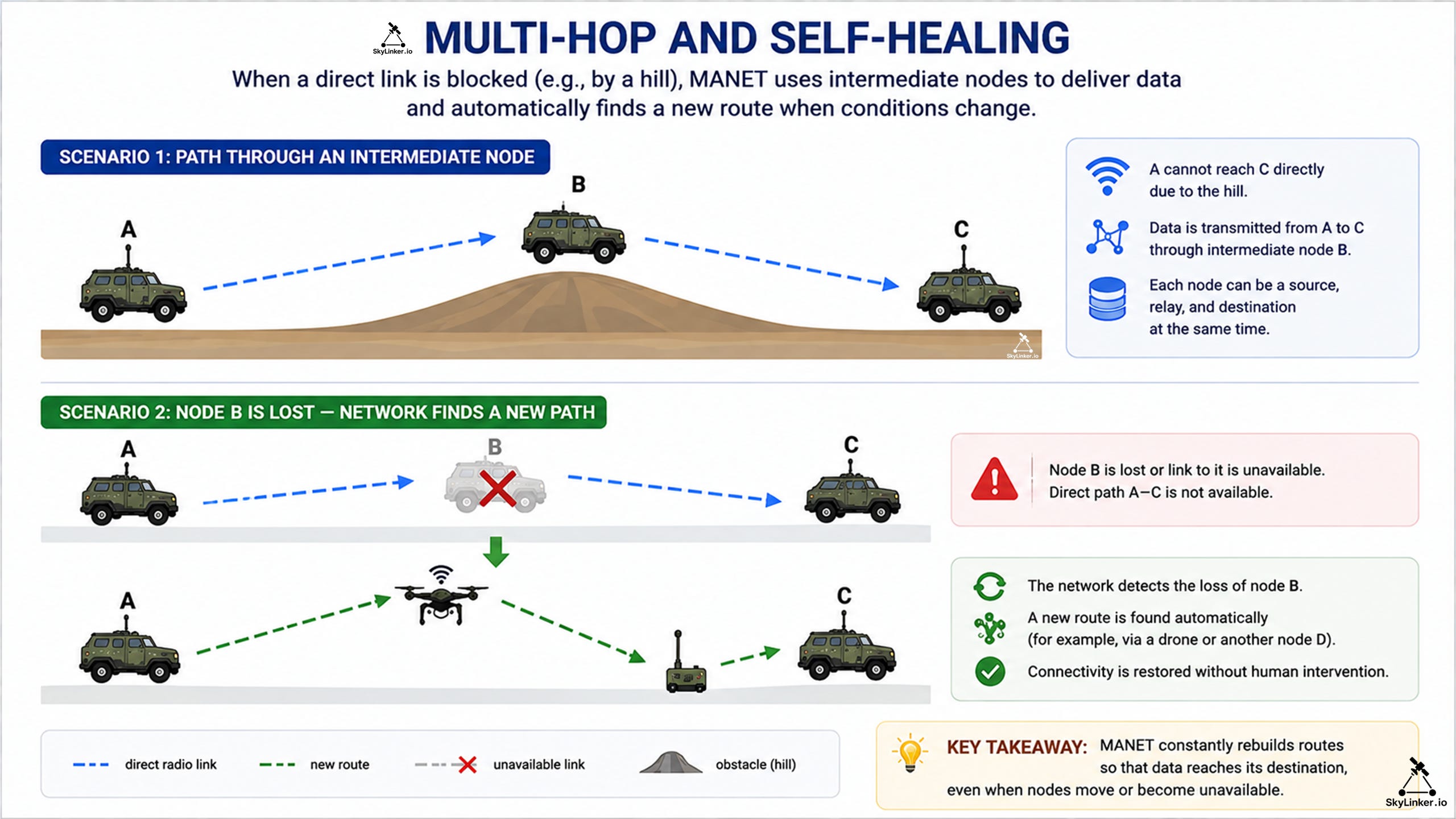
The first vehicle can see the second over a radio link. The second can see the third. The first and third cannot hear each other directly because there is a hill between them.
In a conventional radio network, this could mean there is no connection.
In a multi-hop MANET, the second vehicle becomes a relay. Data from the first vehicle passes through the second and reaches the third. If the second vehicle moves elsewhere, the network will try to find a new path — for example, through a drone or a fourth vehicle.
Each node in such a network can perform several roles simultaneously. It can be a data source, a data destination, and an intermediate point for forwarding other nodes’ traffic.
This is exactly what makes MANET fundamentally different from a model in which all users depend on a single base station.
The IETF — the Internet Engineering Task Force, that is, the community that develops the Internet’s core technical standards — describes a MANET as an autonomous system of mobile nodes with a dynamic, often multi-hop topology. Such a network can operate on its own or have gateways to external infrastructure.
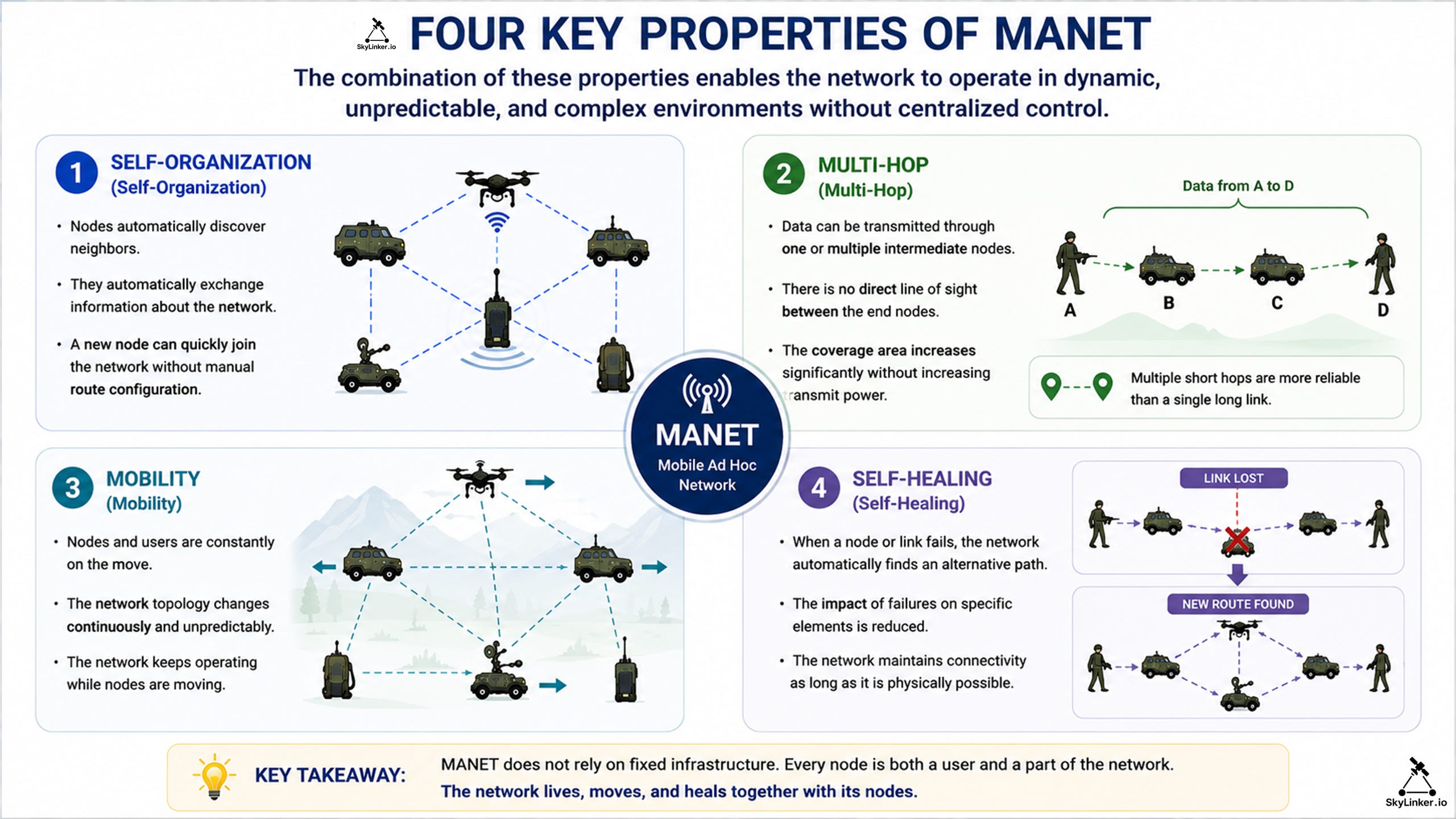
This definition gives rise to the four key properties of MANET.
First — Self-Organization. A node that has been powered on and properly configured should discover its neighbors and join the network without each route having to be set up manually.
Second — Multi-Hop. Data can travel through one or more intermediate nodes.
Third — Mobility. It is not only the users’ positions that change. The very nodes that make up the transport infrastructure are moving.
Fourth — Self-Healing. When one of the radio links is lost, the network looks for another available path.
But here it is important to avoid magical thinking. Self-healing does not mean immortality. If there is physically no external communications link of any kind between two parts of the network, no algorithm will create one out of thin air. A MANET does not cancel out terrain, shadowing, obstacles, interference, insufficient power, or spectrum limitations.
A MANET is simply much better adapted to living in these conditions.
What Kind of MANET This Article Is About
MANET as a general concept is not tied to a single layer of the network model or to a single protocol. There are a great many different engineering implementations and approaches.
Historically, the IETF working group focused primarily on IP — the Internet Protocol, that is, the protocol for addressing and delivering packets between network nodes that is used on the Internet. The IETF developed routing mechanisms suitable for both static and mobile wireless topologies.
In this article, we deliberately narrow the topic to the variants that are currently of greatest interest to the military and to manufacturers of communications equipment, drones, and other military hardware.
We are interested in systems that give connected equipment familiar Ethernet — the wired local area network technology — and IP transport. First and foremost, these are solutions that provide a transparent or near-transparent L2 — Layer 2 service, that is, the data link layer of the network model.
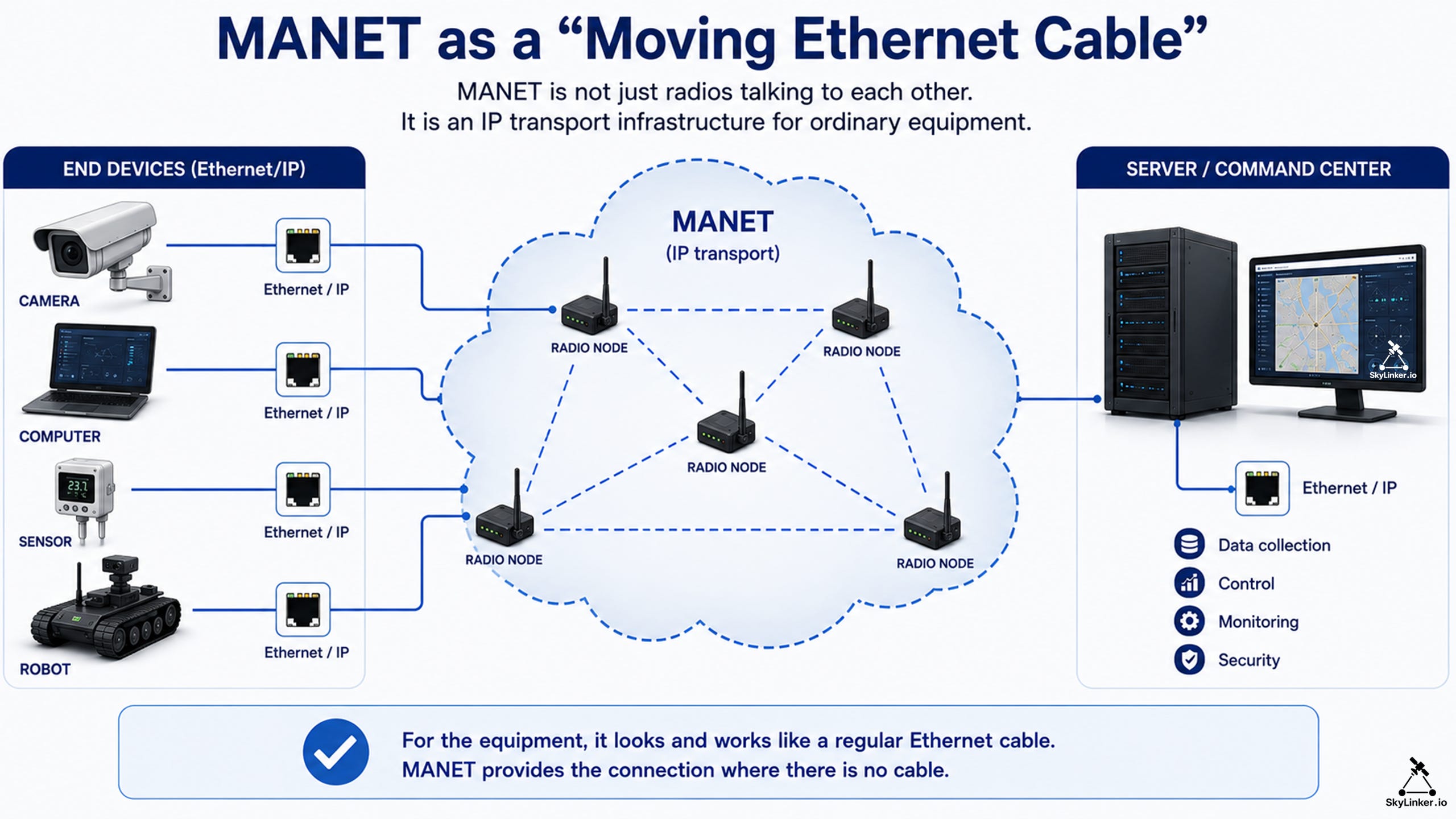
To a camera, computer, server, sensor, or robot controller, such a MANET can look like a very long wireless Ethernet cable. Only this cable is made up of many moving parts, can reconfigure itself on the fly, and has no single fixed route.
This function is often called backhaul — the transport connection between local devices and other network segments. From here on, we will mostly refer to it simply as the transport network.
The practical value of this approach is enormous. A connected camera does not need to know that there are three radio hops between it and the server. A situational awareness application does not need a separate version for every type of radio. A robot controller is not required to search for neighboring nodes on its own — the MANET itself takes care of that.
Internally, different systems may work differently. Some use classic IP routing. Others use proprietary distributed forwarding algorithms. Some solutions operate at the data link layer, while others merely produce a similar result for the user.
So our main criterion is not the name of the internal protocol. The main criterion is whether the connected equipment receives a familiar network service that keeps working while the nodes are moving.
Persistent Systems explicitly describes its Wave Relay as a system providing continuous Layer 2 network connectivity for cameras, video encoders, IP sensors, and other devices. Rajant likewise builds its architecture as a distributed Layer 2 network capable of combining various wired and wireless transports.
Why MANET Is More Than Just Mesh
The term mesh network refers to a network in which nodes can have multiple connections to one another and data can travel along different paths. This capability is an important property of MANET as well. But a mesh structure alone is simply not enough for most modern tasks.
A home Wi‑Fi system — the widespread wireless local area network technology — can also have several mesh access points. One is in the living room, another is upstairs, a third is in the garage. If one path degrades, the system can use another. That is mesh. More precisely, Wi‑Fi mesh.
But these access points do not usually drive down different roads, fly behind buildings, disappear behind terrain, or switch on and off dozens of times during an operation. Their topology is relatively stable.
In a MANET, the transport infrastructure itself can be mounted on people, vehicles, ships, aircraft, drones, and robots. It has to work when neighbors are constantly changing, radio links appear and disappear, and the best route a minute ago is no longer the best one now.
Mesh primarily describes a way of connecting. MANET describes a network’s ability to live in motion.
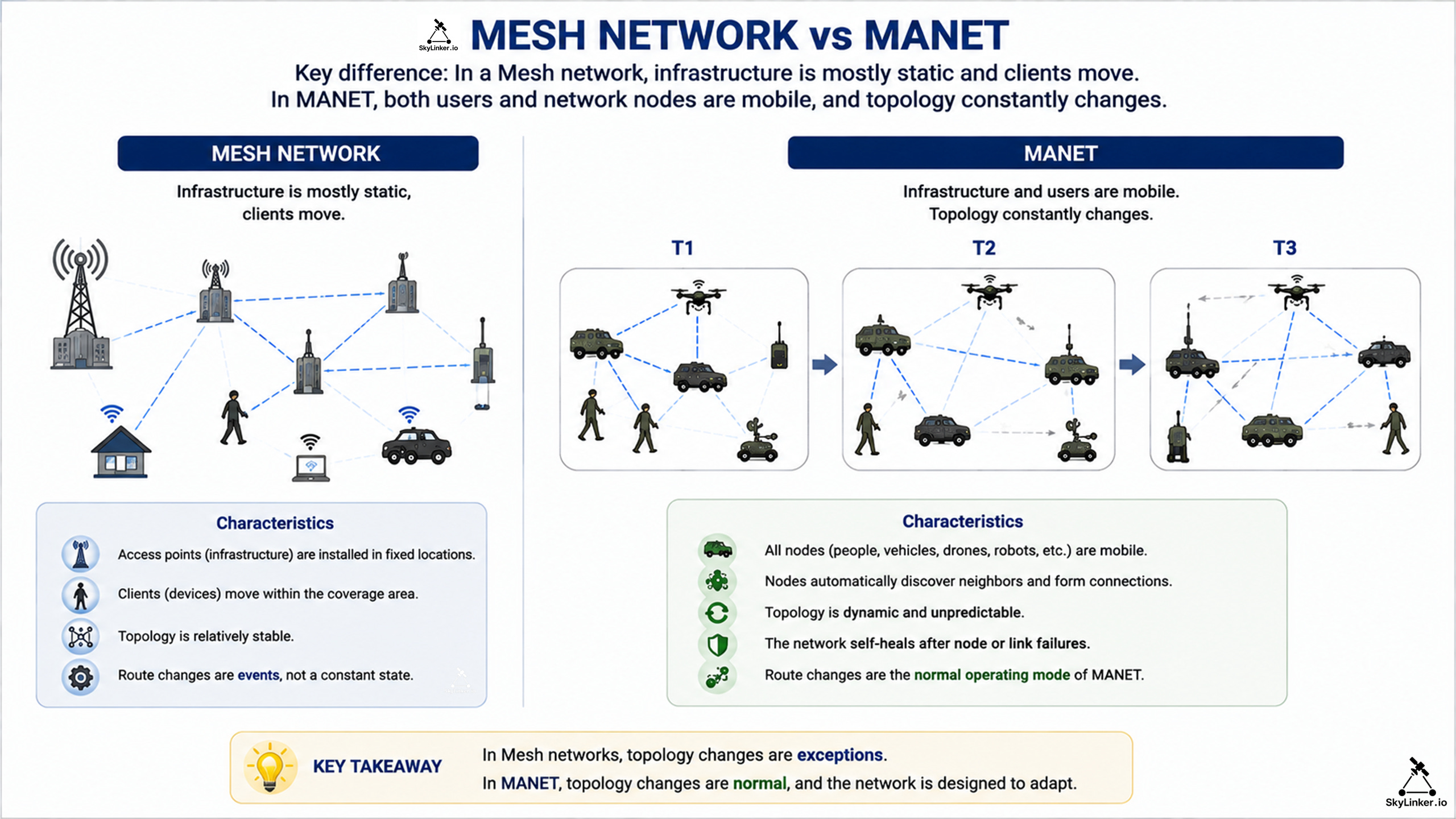
That is why not every mesh network is a MANET. At the same time, most modern MANETs have a multi-hop mesh structure. Hybrid architectures are also possible, where some nodes are stationary and others are mobile. The IETF explicitly takes such hybrid networks into account in its work on MANET standards.
The difference can be put even more simply — in a conventional mesh network, a topology change is usually the exception. In a MANET, a topology change is the normal mode of operation.
The key distinction between MANET and other typical mesh networks can be considered to be precisely its adaptive algorithms for dynamically reconfiguring the network topology, and the ability of its nodes to handle the delivery of data packets under conditions of constantly changing delivery routes, with minimal losses.
It is worth noting that besides Wi‑Fi mesh, there are a great many different consumer and industrial mesh networks that, at first glance, could be classified as MANETs.
These are primarily the widely known smart-device (IoT) solutions, for example those using LoRa, Zigbee, Z-Wave, Thread, Bluetooth Mesh technologies, and the like. Such networks can also be self-organizing, multi-hop, and able to automatically route around unavailable nodes. However, they are usually designed for relatively stable device placement and a completely different usage model.
But most importantly, all such solutions are designed for very small amounts of data and short distances. In other words, they are not capable of carrying video streams from drones to operators, or even of providing voice communications for units.
How the Idea of a Network That Survives Change Came About
The history of MANET began long before the name itself appeared.
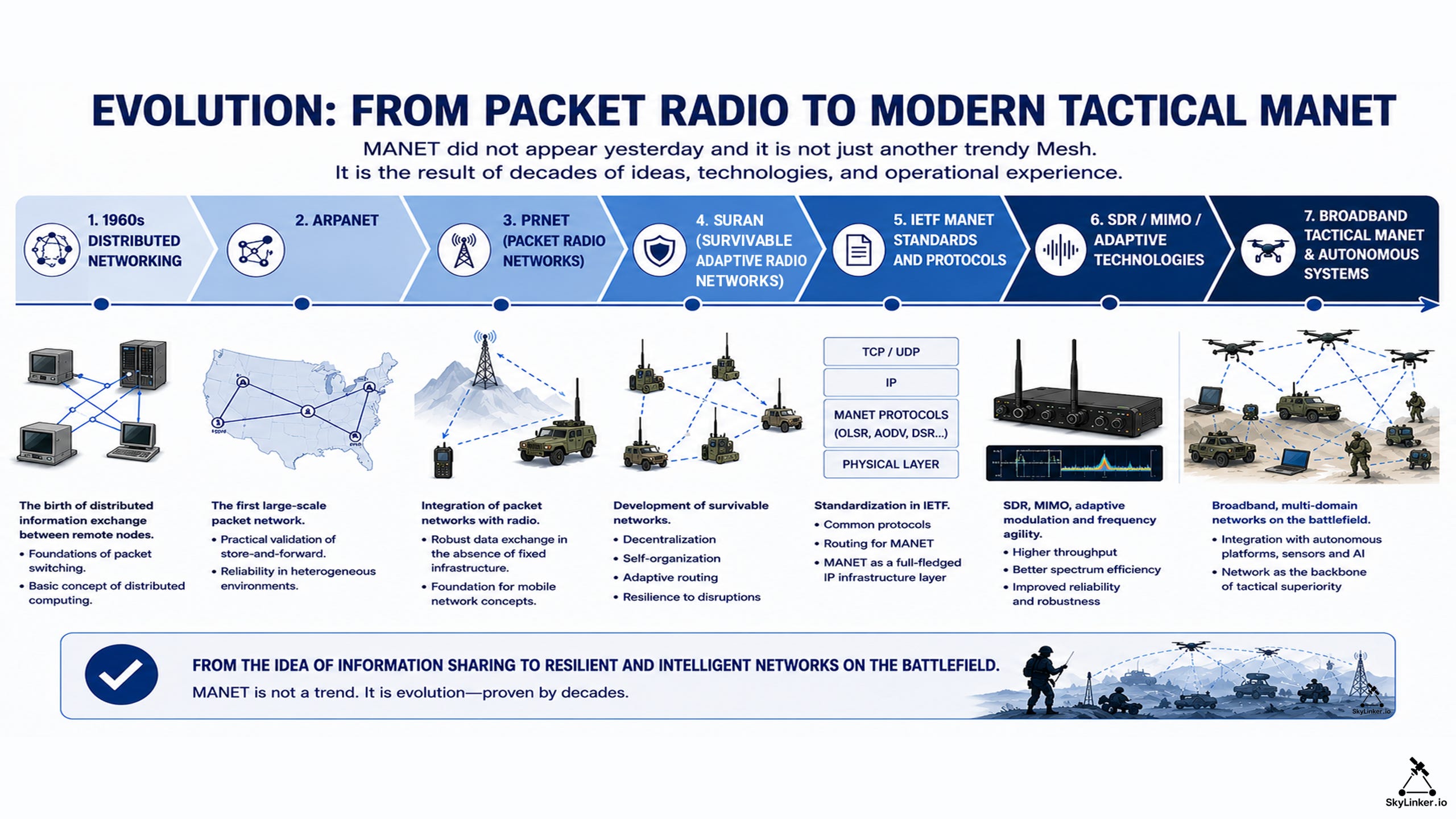
As early as the 1960s, researchers were trying to figure out how to create a network that did not depend on a single center and would not collapse when an individual node or link was lost. RAND studies described a distributed network in which messages are broken into blocks, passed through intermediate nodes, and can change their path depending on the state of the network. The idea was born primarily out of the requirement for survivable communications.
In 1969, ARPANET — the Advanced Research Projects Agency Network, that is, the network of the U.S. Advanced Research Projects Agency — went live. It became one of the main predecessors of the modern Internet.
But ARPANET relied mainly on fixed lines. For military applications, this was not enough. The U.S. Department of Defense needed a network capable of connecting tanks, aircraft, ships, and other mobile platforms. That required radio and satellite links.
In the 1970s, experiments began with PRNET — the Packet Radio Network. Instead of a continuous dedicated channel, information was transmitted in individual packets. Nodes could forward them onward, and the network could build a path across several radio hops.
In 1977, a landmark demonstration took place: data was transmitted across three different networks, one of which was a mobile packet radio network. An experimental van drove along, transmitting information over radio, and the traffic then passed through other networks. This was one of the moments when the idea of a “network of networks” stopped being merely a theory.
In the 1980s, the SURAN program developed technologies for survivable adaptive radio networks for the modern battlefield. The research covered distributed control, reliable data transmission, security, and the operation of large packet radio networks.
In the 1990s, the concept of MANET became a distinct area of network engineering. In 1999, the IETF published RFC 2501 — a document that systematized the fundamental properties of MANETs and the issues involved in evaluating such networks. It already addressed mobile platforms, rapidly changing topology, the limited bandwidth of radio links, and the need to maintain IP connectivity in a dynamic environment.
In the early 2000s, several well-known experimental MANET protocols emerged. Some searched for a route only when it became necessary. Others continuously maintained a map of the network. Still others allowed the source itself to specify the sequence of intermediate nodes. Among others, the IETF described AODV, OLSR, and DSR — different approaches to routing in mobile multi-hop networks.
But true maturity did not come from algorithms alone.
Digital processors shrank. Signal processing speeds increased. SDR — software-defined radio, in which a significant share of functions is implemented in software — became widespread. MIMO — Multiple Input Multiple Output, that is, transmitting and receiving signals over multiple antenna channels, matured.
Radio, routing, encryption, network management, and Ethernet interfaces began to be combined in a single compact device. It became possible to use technologies and solutions on the battlefield that had previously been available only in the office, or wherever network infrastructure was available.
MANET was no longer just an almost mathematical problem about routing tables. It became a ready-to-use transport platform. A new round of battlefield digitalization had begun.
The Civilian World: Where Infrastructure Can’t Keep Up with Reality
MANET’s military origins do not mean that the technology is needed only by the military. On the contrary, civilian applications clearly demonstrate its practical value without the influence of combat-specific factors.
The cleanest example is the mining industry.
An open-pit mine is constantly changing. Haul roads are relocated. Equipment moves around. Terrain changes after blasting. A fixed site that had good line of sight yesterday may find itself behind a new obstacle today.
Moreover, a modern mine or quarry is no longer just about voice communications. It means autonomous haul trucks, remote equipment control, cameras, safety systems, telemetry, and production data.
For example, Rajant reports that its Kinetic Mesh is used in more than 300 mines and quarries in over 80 countries. Its nodes can be installed both on fixed sites and on mobile equipment, creating links between machines and other infrastructure.
The second example is emergency response services.
After a fire, flood, earthquake, or industrial accident, conventional infrastructure may be overloaded, damaged, or unavailable precisely where it is needed most.
In such cases, temporary MANET nodes can be installed on vehicles, portable masts, drones, or robots. The network will connect cameras, sensors, rescue teams, and a mobile command post. And one of the gateways will be able to pass the necessary data onward over a satellite or cellular link.
Rajant and Silvus describe exactly these kinds of scenarios for police, firefighters, emergency services, robotic systems, and temporary video surveillance systems. In both cases, MANET does not replace existing networks but extends them into areas they cannot physically reach.
The third example is robotic warehouses and industrial automation.
In a large automated warehouse, dozens of robots can be moving at the same time. All around are metal structures, racks, cargo, and constant radio signal reflections. A brief loss of a command can stop a machine, and a chain of such stoppages can halt an entire production system.
In one project described by Doodle Labs, a network of roughly one hundred nodes provided connectivity to mobile warehouse platforms that were constantly moving between coverage zones.
All of these examples share one pattern — MANET becomes especially useful where the physical topology of the environment changes faster than traditional telecommunications infrastructure can be rebuilt.
On the battlefield, this pattern manifests itself in its harshest form.
Why the Battlefield Is MANET’s Natural Environment
On the battlefield, almost everything moves and changes unpredictably.
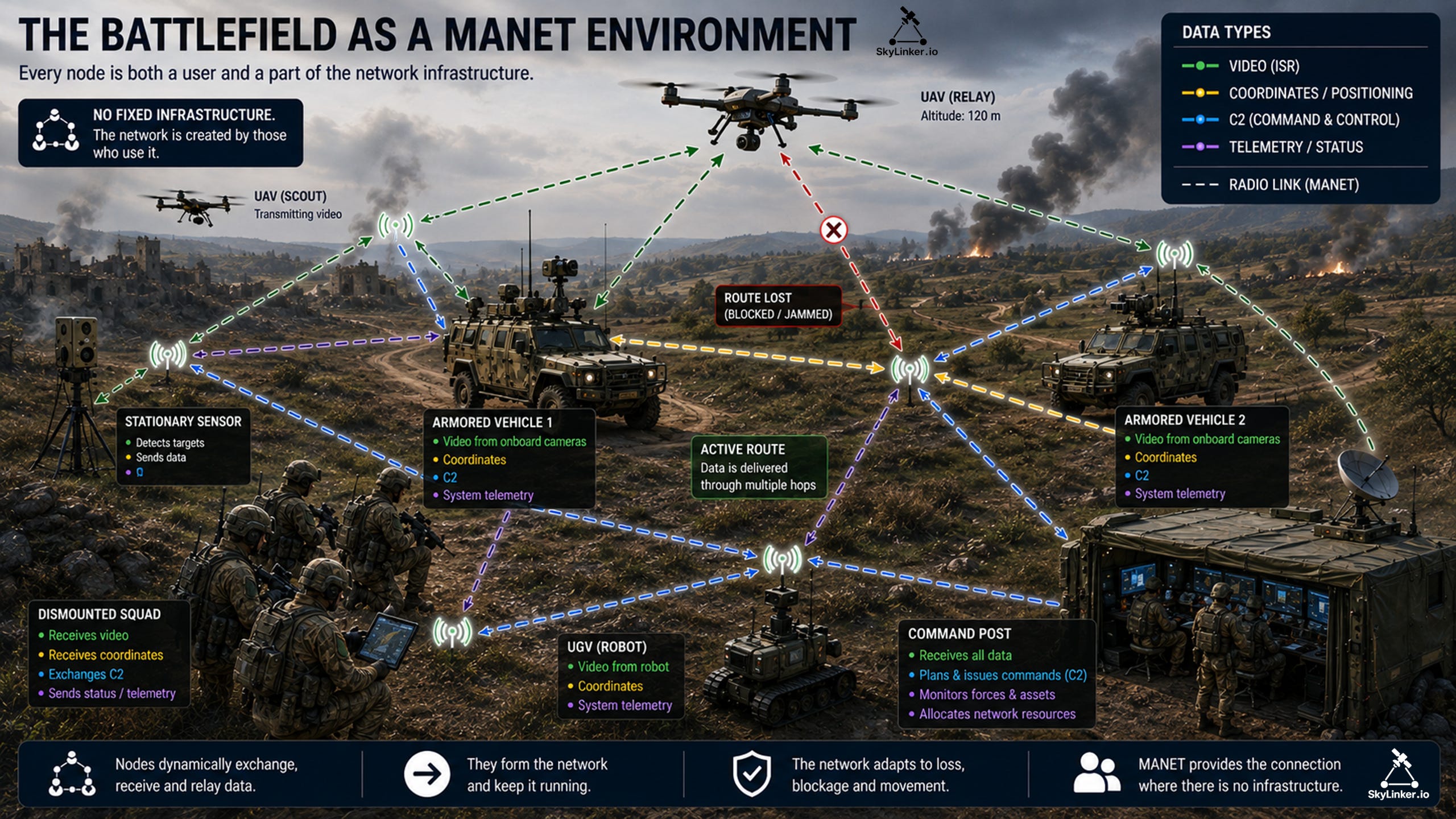
People change positions. Vehicles disperse. Drones take off, land, or drop off the network. Ground robots enter built-up areas. Command posts relocate to avoid becoming targets.
Terrain blocks line of sight. Buildings cause reflections. Vegetation attenuates the signal. The RF environment changes. The adversary creates interference and tries to detect emitters.
On top of that comes the physical destruction of nodes.
In a traditional civilian network, an engineer tries to build stable infrastructure and connect mobile users to it.
On the battlefield, the stability of the infrastructure itself cannot, to put it mildly, be taken for granted.
MANET offers a different model: make people, vehicles, aircraft, sensors, and robotic systems part of the transport network.
A dismounted operator does not just receive data. Their radio node can forward traffic to a neighboring operator.
A vehicle does not just use the network. It can be a powerful relay for the unit.
A drone does not just conduct surveillance. Thanks to its altitude, it can create a radio bridge between two groups separated by terrain. Or serve as a relay for an entire group of drones.
This network carries more than just voice. It can carry coordinates, text messages, commands, telemetry, video, sensor data, and information for C2 — Command and Control.
The same transport network can be used by TAK — Team Awareness Kit systems, that is, a software ecosystem for shared situational awareness — as well as by cameras, navigation devices, servers, ground robots, and unmanned platforms.
This is how MANET turns from a “radio network” into mobile digital infrastructure.
The U.S. Army’s Integrated Tactical Network (ITN) combines radios, applications, end-user devices, gateways, and multiple types of transport. U.S. Army documentation describes this architecture as expeditionary, mobile, and built on multiple communication paths so that the network remains operational in a congested or contested environment.
However, MANET does not mean that every node is always connected to every other node.
Sometimes the network will split into several parts. Sometimes a path will be suitable for short messages but not for video. Sometimes a node will have a good link to a neighbor but a poor one in the reverse direction.
The task of a good MANET is not to conceal the laws of radio physics. Its task is to make better use of every available opportunity than a static network would.
How a Modern Tactical MANET Works
From the user’s point of view, everything should look simple.
There is a camera. It is connected to a radio node with an Ethernet cable.
There is a workstation. It is connected to another radio node.
Between them, there may be a vehicle, a drone, and another portable relay. But the camera and the workstation see an ordinary network.
The MANET node itself usually combines several functions.
It contains an RF front end, a digital modem, encryption, a network processor, neighbor discovery algorithms, path selection mechanisms, and interfaces for external equipment.
Once powered on, the node listens to the airwaves and finds other compatible nodes. It evaluates the available links. This may include not only whether a link exists, but also the current signal quality, interference level, throughput, load, and stability of the neighbor.
The network then decides which path to use for the traffic.
The shortest path is not always the best. A single hop over a congested or unstable link can be worse than two hops over cleaner links.
In a MANET system, networking decisions are tied to the actual state of the RF environment. That is why a modern MANET cannot be reduced to a routing protocol alone. The waveform, access to the shared medium, antennas, multipath handling, power control, and the interaction between the radio modem and the network logic all matter.
A single node can run several types of interfaces simultaneously. For example, MANET radio, Ethernet, Wi‑Fi, a satellite terminal, and a cellular modem.
Then the node becomes more than just a relay.
It becomes a gateway between different networks.
Edge computing — processing data close to where it is generated — plays an important role here. If video from a drone is needed by an operator in a nearby vehicle, there is no point in first sending it to a remote server and then bringing it back.
Local traffic should stay local.
And the external link should be used for the information that truly needs to go beyond the unit.
This is exactly where SATCOM comes in.
MANET and SATCOM: The Neighborhood and the Horizon
SATCOM — satellite communications.
It was precisely the availability of broadband, jam-resistant Starlink satellite communications that enabled Ukraine’s defenders to accelerate the transition into the era of drone warfare — particularly in scenarios where no other means of communication could provide comparable connection parameters.
SATCOM is often listed alongside MANET among military technologies. This can create the misconception that a unit must choose one or the other: either a mobile mesh radio network or satellite communications.
In reality, they solve different problems:
MANET creates a local, mobile network among people, vehicles, sensors, and robotic platforms.
SATCOM provides long-haul communications beyond that local network.
MANET provides the digital neighborhood.
SATCOM provides the horizon.
Most terrestrial MANET links depend on line of sight or near line of sight. Relaying through intermediate nodes helps get around terrain or buildings, but communicating over hundreds or thousands of kilometers requires a different transport.
This role can be filled by BLOS — Beyond Line of Sight communications. SATCOM is one of its main forms.
A typical architecture looks like this:
Dismounted teams, vehicles, drones, and sensors form a MANET. One or more vehicles carry satellite terminals. Traffic from a remote node travels several MANET hops to such a vehicle and then goes over the satellite link to headquarters, a data processing center, or another unit.
A drone transmits video to a vehicle over the MANET.
The vehicle distributes that video to local operators.
Only a selected stream, individual frames, coordinates, or a short message may go to higher headquarters via SATCOM.
In such an architecture, a single satellite terminal can serve many MANET nodes. There is no need to install a separate satellite antenna for every user.
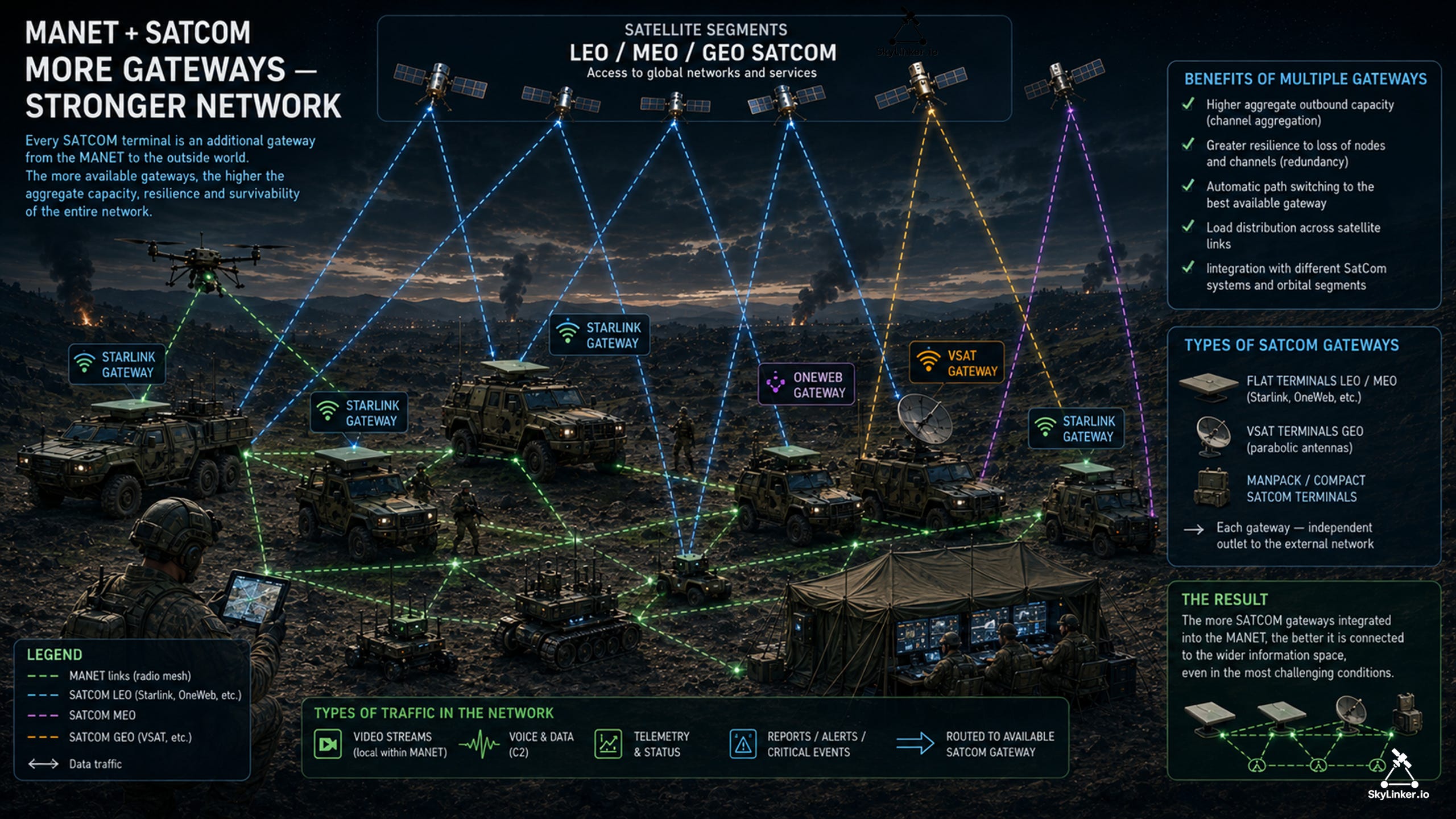
The U.S. Army describes a similar model as extending a MANET with an external Internet connection. An external access source, such as a satellite terminal, is connected to the mesh radio network. Users who are several radio hops away from the terminal can then access external resources.
An external transport network can be used to link geographically separated MANET segments into a single MANET.
This architecture provides another important advantage: the local network does not have to stop working when the satellite link is lost.
Without SATCOM or other external connections, a unit may temporarily lose its connection to a remote headquarters or cloud services. Even so, local MANET nodes can still exchange coordinates, messages, commands, video, and telemetry.
In other words, losing global reach does not necessarily mean losing local connectivity.
And vice versa. If a terrestrial MANET has split into two or more geographically separated parts, any available external connections (including satellite gateways) provide a fault-tolerant link between them.
This does not make the system invulnerable. Satellite links can also be congested, blocked, unavailable due to local conditions, or disrupted by electronic warfare. That is why a modern military network should not depend on a single satellite, a single frequency band, or a single terminal.
Modern SATCOM increasingly uses several types of orbits:
LEO — Low Earth Orbit.
MEO — Medium Earth Orbit.
GEO — Geostationary Earth Orbit.
Each has its own advantages and limitations in terms of coverage, latency, terminal availability, and network structure.
The U.S. Army is developing a multi-path architecture in which systems can use multiple orbits, frequency bands, terrestrial line-of-sight links, and other types of transport. The idea is to make switching between the available paths as automatic and as seamless to the user as possible.
Within this system, MANET does not compete with SATCOM.
It aggregates local traffic, distributes it at the tactical edge, and delivers it to the available external gateways, adapting to their presence and availability.
SATCOM carries selected traffic over long distances.
MANET manufacturers are already building in similar logic. For example, Persistent Systems describes Cloud Relay as a means of maintaining network connectivity during transitions between SATCOM, cellular networks, and other transports. In its announcement about the British CAIN project, the company explicitly presents Wave Relay MANET and Cloud Relay as parts of a single system, not as interchangeable products.
There is another reason to keep local traffic inside the MANET.
Satellite capacity is a valuable, often constrained resource. Even if a modern link offers high speeds, not all information needs to go through it.
A camera feed watched by an operator in a vehicle two MANET hops away can stay local. A ground robot’s telemetry can be processed on a local server. What goes over the satellite is what remote command actually needs.
Thus, MANET does more than just use SATCOM. MANET helps use satellite resources more wisely.
Five Implementations, Five Different Lessons
The MANET market is not limited to a single protocol or a single type of radio.
Different manufacturers solve the mobile networking problem in different ways. So it is more productive to view them not as a simple ranking, but as examples of different architectural approaches.

Persistent Systems: Wave Relay — Ethernet on the Move
Wave Relay from Persistent Systems is one of the clearest examples of MANET as wireless Ethernet infrastructure.
MPU-family devices connect cameras, sensors, computers, unmanned platforms, and other IP devices. The manufacturer specifically emphasizes transparent Layer 2 network connectivity and the ability to connect equipment without developing a special protocol for each device.
The value of this approach is clearly visible at the system level.
A drone, a ground robot, a camera, and a command tablet can all end up in the same network ecosystem. If one node has an external link, the others can access it through the MANET.
In March 2026, Persistent Systems announced that Wave Relay and the MPU5 had been selected for the British CAIN project. In the same announcement, the company stated that more than two thousand MPU5s had previously been delivered to the Royal Marines, and that the new architecture provides for the use of Cloud Relay for switching between satellite, cellular, and other transports. These figures come from the manufacturer itself, but they show that this is no longer just a laboratory experiment.
In June 2026, Persistent Systems reported the successful test of a Wave Relay MANET with 800 nodes connected simultaneously, based on MPUs and specialized embedded modules for drones and vehicles.
The main lesson of Wave Relay is simple: a MANET can be a general-purpose mobile backbone network, not a separate link for a single specialized application.

Rajant: Industrial Mobility at Scale
Rajant Kinetic Mesh is particularly interesting because of its extensive civilian track record.
Rajant’s architecture operates at Layer 2 and can combine wired and wireless connections. Nodes evaluate the available paths and forward packets over suitable links as conditions change.
In industry, these nodes are installed on haul trucks, excavators, robots, port equipment, and other mobile assets. According to the company, its networks operate in more than 300 mining operations in over 80 countries.
Rajant also promotes a model in which a single distributed network combines Ethernet, Wi‑Fi, cellular networks, satellite communications, tactical radios, and other transports. In this model, a new technology does not require throwing away the old infrastructure. Instead, it overlays a shared mobile network layer on top of it.
The main lesson of Rajant: MANET can be not only a military communications tool but also a mature industrial infrastructure for environments where movement is a constant operating condition.

Silvus: The Network Starts with Radio Physics
The StreamCaster systems from Silvus show how important the physical RF layer is for MANET.
At the core of these systems is the combination of mesh networking and multi-antenna MIMO processing. The radios have Ethernet and other interfaces and can connect people, vehicles, sensors, unmanned platforms, and command posts.
In an article by the U.S. Army’s 25th Infantry Division, StreamCaster is described as a MANET system in which radios can join the network, leave it, and relay voice, data, and video. Particular emphasis is placed on the ability to share the capacity of a single external transport link among multiple network nodes.
This example is a reminder: a good algorithm will not save a weak radio link. Operating on the move, in built-up areas, or without line of sight requires the joint optimization of the radio signal, antennas, medium access, and network logic.
The main lesson of Silvus: MANET is not routing bolted on top of any radio. The radio and the network must be designed as a single system.

TrellisWare: MANET Without a Classic Routing Table
TrellisWare demonstrates another important point: a MANET does not have to work the way a conventional router does.
Its TSM — Tactical Scalable MANET, that is, a scalable tactical MANET waveform — uses Barrage Relay, a distributed relaying mechanism that does not rely on classic route formation in the way it is usually understood in IP networks.
The system supports voice, position location information, and Ethernet-based data, including multicast video. TrellisWare positions it as a platform for large mobile networks.
The U.S. Army has described TSM as a component of the Integrated Tactical Network that provides simultaneous voice and data transmission and allows each node to receive, transmit, and relay information.
The main lesson of TrellisWare: MANET is not defined by a specific routing algorithm. It is defined by whether the network can maintain connectivity, scale, and adapt to movement and link loss.

Doodle Labs: The Network as a Component of the Robotic Platform
Doodle Labs focuses primarily on unmanned and robotic systems.
Its Mesh Rider — a family of compact mesh radio modules — is designed to be embedded in drones, ground robots, maritime platforms, and portable equipment. The modules have Ethernet interfaces, support multi-hop operation, and can carry commands, telemetry, and video.
The Defense Innovation Unit — the U.S. Department of Defense organization that accelerates the adoption of commercial technologies — included Doodle Labs radio modules on its list of components selected for the Blue UAS ecosystem of vetted unmanned systems.
The company also describes integrations of its radio modules into unmanned aerial and maritime platforms, where MANET is used for communications among multiple mobile vehicles and ground control stations.
The main lesson of Doodle Labs: MANET is increasingly becoming not a standalone radio carried by an operator, but an embedded part of the robotic system.
These five examples should not be compared solely on maximum data rate or claimed range. They are designed for different scales, frequency bands, types of mobility, and usage models.
The real question is not “Which radio is the best?” The real question is which architecture best fits a specific networking problem. And when it comes to Ukraine’s experience, it is the platform approach of Wave Relay from Persistent Systems that currently looks like the solution with the greatest potential.
How to Evaluate a MANET Without Falling into the Trap of Impressive Numbers
It is easy to find the maximum data rate, range, and number of nodes in a radio’s datasheet. These figures are useful. But they almost never fully describe a real network.
One hundred megabits per second over a single clean radio link between two stationary nodes does not mean one hundred megabits between two vehicles across four hops in a built-up area.
Ten kilometers over a clear line-of-sight path between elevated antennas does not mean ten kilometers between two dismounted operators in a forest.
Support for five hundred nodes does not mean that all five hundred can transmit video at the same time.
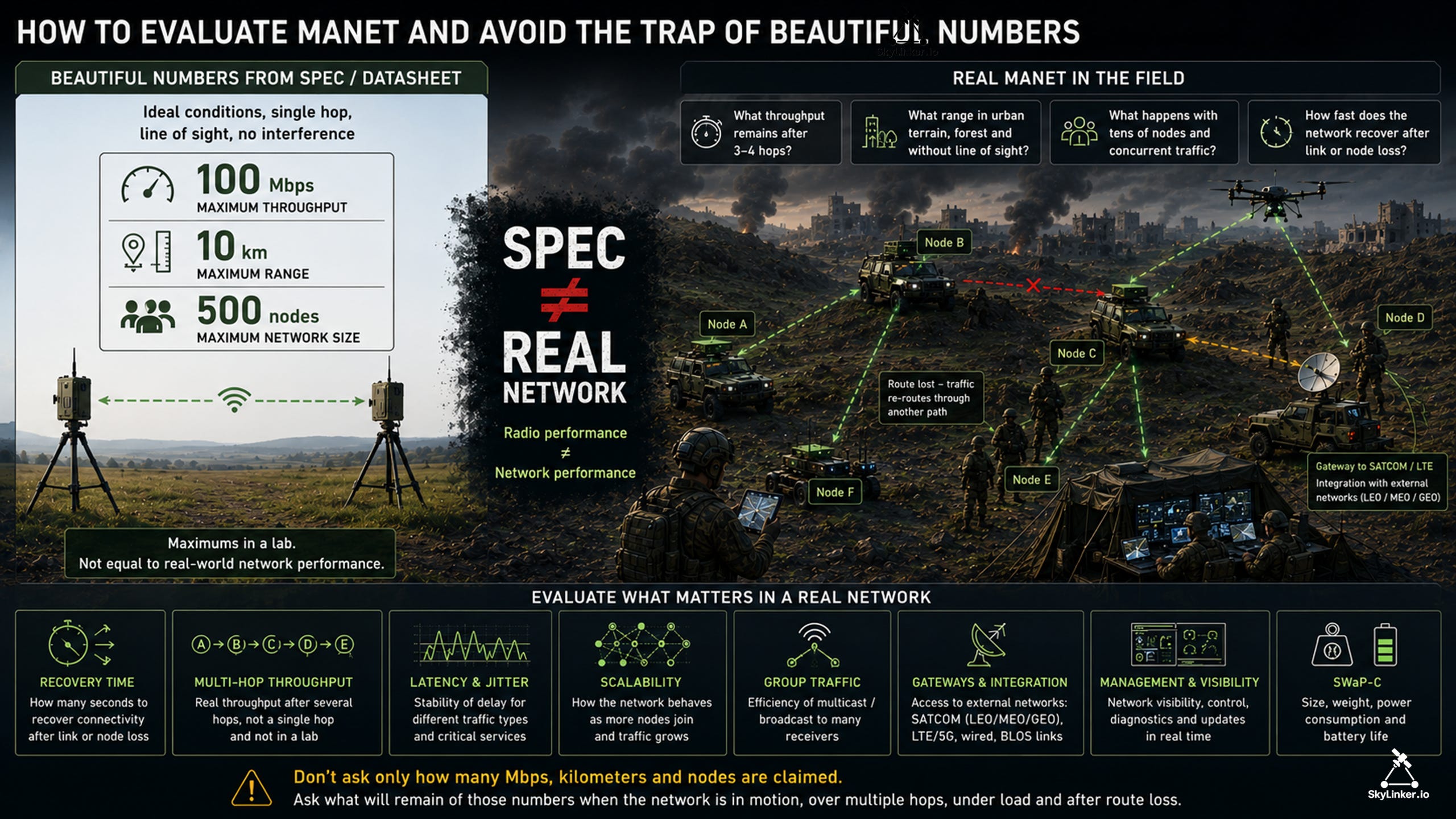
The first important MANET metric is recovery time after a change.
What happens when a relay disappears? How quickly will the network notice? When will it find another path? How many packets will be lost? Will a voice call drop? Will the video freeze? Will the system flap back and forth several times between two unstable routes?
The second metric is effective throughput across multiple hops.
Every relay hop consumes airtime. If all nodes operate on the same frequency channel, an intermediate node first receives a packet and then transmits it onward. At the same time, other nodes may be competing with it for airtime.
Throughput does not necessarily decrease according to a simple formula. The result depends on the number of radio modules, frequencies, the medium access method, spatial separation, and the nature of the traffic.
But every additional hop comes at a cost.
The third metric is latency and its stability.
For a file download, brief fluctuations in latency may go unnoticed. For voice, remote control, coordinates, or video, they already matter.
Average latency on its own says little. What matters is how it behaves under load, during route reconfiguration, and in the presence of interference.
The fourth metric is scalability.
Each node adds not only a useful relay but also control messages, contention for airtime, and new possible routes. It is important to assess how the control overhead grows and whether the network spends a significant share of its time constantly recomputing its own state.
The fifth metric is multicast and broadcast traffic.
Situational awareness data, coordinates, voice talk groups, and video are often sent to more than one recipient. A network that handles exchanges between two nodes well may perform much worse when a single message has to be delivered to dozens of participants.
The sixth metric is gateway behavior.
What happens if two satellite terminals appear on the network? Which one will be used? Can traffic be split between them? Will the system fail over to a cellular link after losing SATCOM? Will local traffic stay local?
The seventh metric is manageability.
A MANET can form automatically, but it still needs to be configured, updated, monitored, and diagnosed. What matters is whether the operator can see node status, link quality, airtime utilization, routes, and the causes of link loss.
The eighth metric is SWaP — Size, Weight and Power.
A radio with excellent specifications may turn out to be unsuitable for a small drone because of its weight. A powerful vehicle-mounted node may be overkill for a dismounted operator. And a compact module designed for a robot may lack the power or number of interfaces required for a command post.
RFC 2501 already warned that the actual throughput of a wireless network, after accounting for shared channel access, signal fading, noise, and interference, can be significantly lower than the radio’s maximum data rate. The document also stressed that congestion is often the norm for a MANET rather than a rare failure.
That is why the best test of a MANET is not a bench setup with two radios.
The best test is a moving network with real antennas, real traffic, obstacles, multiple hops, node loss, and the same external transports that will be used during the operation.
The Cost of a Mobile Network
MANET has strong advantages. But each of them comes at a cost. Multi-hop operation extends reach, but it consumes additional airtime and transport resources.
A large number of nodes creates more possible paths, but at the same time it increases contention and control overhead.
Frequent topology updates help the network respond to changes faster, but they require more frequent exchanges of control messages.
High transmit power can increase range, but it also increases power consumption, mutual interference, and the detectability of emissions.
A transparent Layer 2 simplifies device connectivity, but it can enlarge the broadcast domain. In a large network, uncontrolled control packets, configuration errors, or excessive multicast traffic can consume a significant portion of the available capacity.
Self-healing does not happen without delay, either. The network first has to recognize that the old path no longer works, then find a new one and switch the traffic over to it. Packet loss and brief outages are possible at that moment.
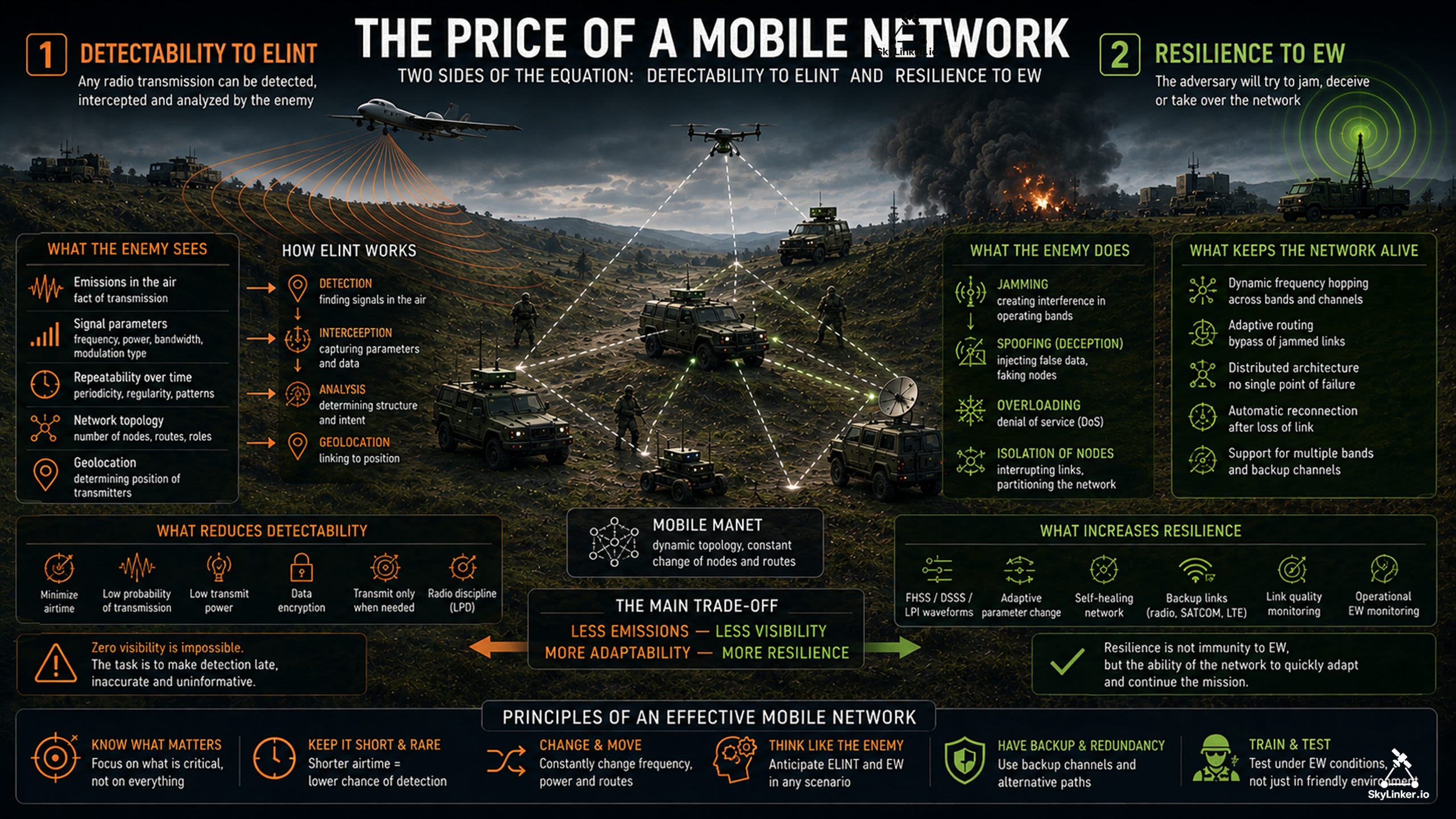
A separate topic is survivability under electronic warfare.
A MANET can route around damaged nodes, change routes, use multiple frequencies, and distribute traffic. This increases resilience.
But no radio network is completely immune to detection or jamming.
Encryption protects the content of the data. It does not necessarily conceal the very fact of emission, the transmitter’s location, the time of activity, or the pattern of communications.
Low power can reduce detectability, but it can also shorten range.
Frequent relaying can improve connectivity, but it can also create more emitters.
That is why MANET is always a trade-off among reach, speed, survivability, power consumption, and RF detectability.
MANET does not cancel out radio physics. It allows you to work more intelligently within its limits.
One Network, Many Transports
The strongest modern military architecture does not try to find a single universal communications technology.
It uses several:
MANET provides mobile local transport.
SATCOM provides long-haul beyond-line-of-sight communications.
LTE — Long-Term Evolution, that is, fourth-generation mobile communications — can be used where civilian or private cellular infrastructure is available.
5G — Fifth Generation, that is, the fifth generation of mobile communications — can provide additional capacity and support private local networks.
Radio relay links can provide high-speed terrestrial transport between points with line of sight.
Fiber optics provide high capacity where they can be laid safely.
HF radio can become one of the backup long-haul paths.
None of these technologies is the best under all conditions.
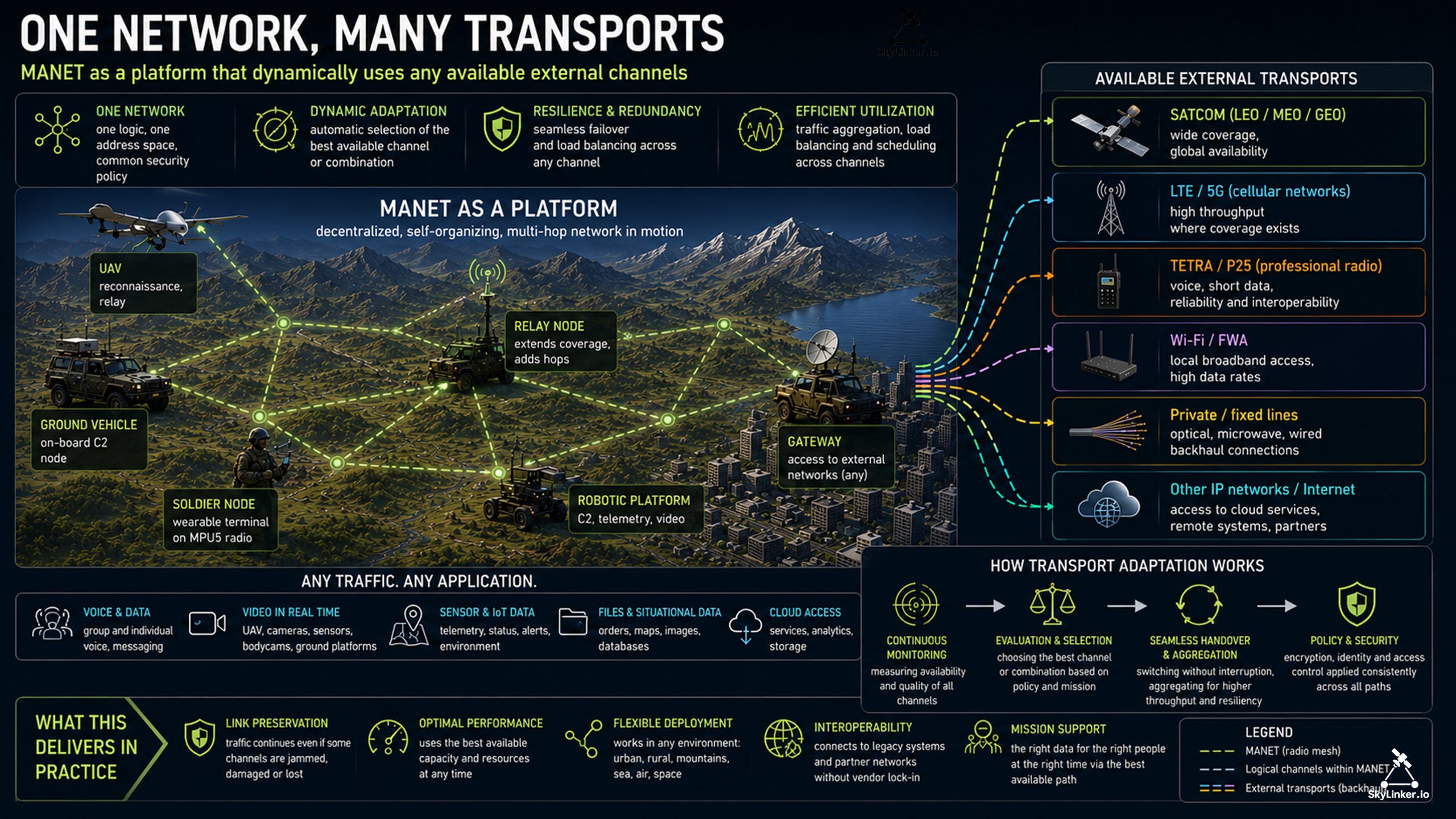
The system’s task is to know which paths are available, what traffic they are suitable for, and how to switch to another transport when the primary one is lost.
The U.S. Army describes the future tactical network as a transport-agnostic system capable of using different satellite orbits, frequency bands, and terrestrial communications. Some modern experimental architectures already combine geostationary and low-Earth-orbit satellite links, 5G, and mesh radio networks, with load balancing across the available transports.
In such a network, drone video can stay inside the MANET. A short target report can go via satellite. A large data package can wait for a fiber-optic or high-speed radio relay connection.
When one path is lost, critical traffic will move to another — perhaps slower, but available. A MANET without external transport can create a strong local network, but it will not provide global reach.
That is why the MANET race will most likely be won by whoever offers a true platform — one capable of building a resilient network on the battlefield without being rigidly tied to an ad hoc “zoo” of disparate solutions. In other words, a platform capable of adapting to any means of communication and any operating conditions. Flexibly and efficiently.
It is precisely the platform approach that enables all these technologies, together, to achieve far more than each of them could on its own.
From Radio to Mobile Digital Infrastructure
MANET is often imagined as a set of radios that can pass packets through one another. This is correct, but still too narrow a view.
A modern MANET is a way to bring network infrastructure wherever its users go.
It allows a camera to stay on the network when a vehicle changes position. It allows a drone to become a relay for a ground team. It allows a single satellite terminal to serve dozens of nodes. It allows robots, sensors, operators, and command systems to use a shared IP infrastructure — possibly one that does not even belong to your unit.
Its main value is not that it “finds the route by itself.” Its main value is that it brings a familiar digital ecosystem into an environment where there is no stable telecommunications foundation.
In the civilian world, this makes it possible to automate mines, control robots, and rapidly deploy communications during emergencies. In the military world, it gives a unit local digital survivability.
MANET maintains connectivity within a mobile group. SATCOM, cellular, radio relay, and wired networks connect that group to the rest of the information space.
The future military network will not be one big radio system. It will be a network of networks — mobile, distributed, multi-path, and able to keep operating even when some of its parts are lost.
Mesh gives it many connections. MANET gives it the ability to live in motion. SATCOM gives it long reach. And together, they create digital infrastructure that moves together with people, vehicles, sensors, and the entire operation.
Of course, any data network requires monitoring and management, as well as appropriate security and encryption mechanisms — especially when it comes to integrating different MANETs into a single large space. But we will leave these issues for future publications.
The support of paid subscribers of SkyLinker.io will allow us to share even better and even more independent analytics, interesting reviews, and produce training and educational materials. From an inexpensive subscription costing a few cups of coffee per month to a more significant “Patron” level — all of this is clearly and qualitatively converted into information and knowledge, primarily for the defenders of Ukraine.
All the most interesting things from the world of communication and space technologies are also available in the form of educational audio podcasts and video lectures both on the website and on the SkyLinker Youtube channel.
Communications: The Nervous System of a Fighting Force

Picture the strongest organism imaginable: powerful muscles, endurance, reflexes, will. Yet whether it can fight at all comes down to one thing — its nervous system. The nervous system adds no strength of its own. It makes strength controllable. The same holds true for the defence of Ukraine: communications are not a service or an accessory that people …
EW vs. Starlink: What Actually Works?

For the fifth year, we have been observing the battlefield changes brought about by LEO SatCom systems, such as Starlink. The practical use of Starlink by the Ukrainian Defense Forces has not only proven the resilience of such communications but also laid the groundwork for the dawn of the “Drone Warfare Era.”
What is Direct-to-Cell from Starlink and how does it work

Just a few years ago, the idea of calling or sending a message from a remote mountain valley directly via satellite using a regular smartphone seemed like science fiction. Today, these are the first field tests. SpaceX with Starlink, along with mobile operators, show that a phone can “reach” orbit
Starlink Onboard Terminals - Ukrainian Engineering Experience

Starlink satellite terminals are a high-tech system that is actively used in many mobile solutions, including all types of drones (UAV, USV, UGV). Maintaining stable communication while moving is quite a challenging task. Starlink developers not only incorporated the relevant functionality into their system during the development stage. They actually performed a gigantic amount of engineering work. But their high-tech result still has certain features and limitations.
Realities and Challenges of Using Starlink on Drones and Vehicles

In one of the previous publications, it was already mentioned how Starlink changed the paradigm of war, enabling the battlefield to generate massive data streams from any component or actor. But Starlink actually changed much more – the satellite communication industry itself became different. And above all, the
Starlink, OneWeb, Kuiper - A Deep Analysis and Comprehensive Comparison

This extensive analytical article contains a deep analysis and comparison of the current leaders in low Earth orbit (LEO) satellite communication - Starlink, OneWeb, and Kuiper. A detailed review of their features, history, and specifics not only provides a complete picture of them but also an understanding of why comparing them solely by the number of …