

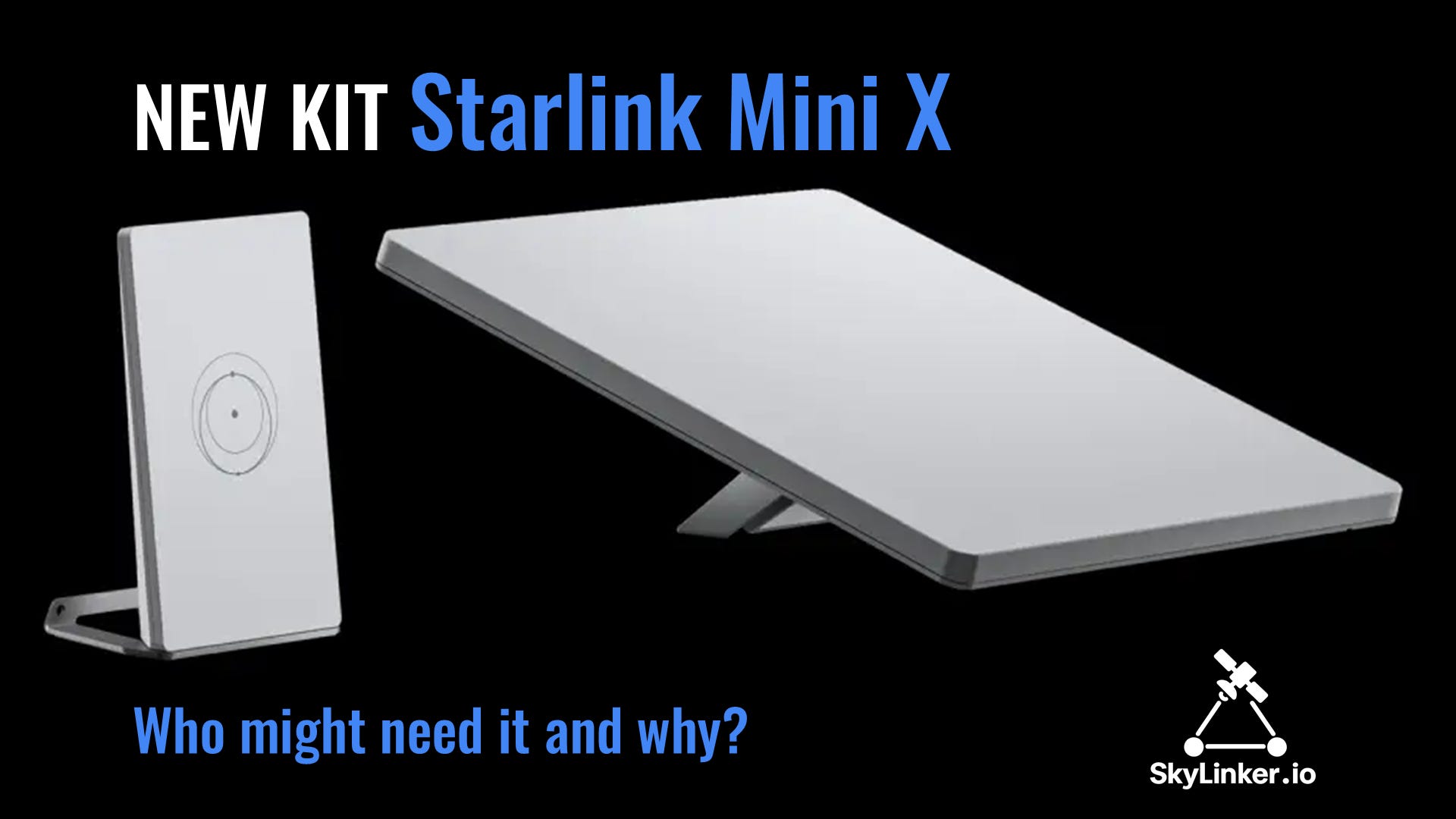
A lot of time has passed since the compact model of the Starlink Mini satellite terminal appeared on the market - the official release of Starlink Mini took place in June 2024. Since then, Starlink Mini has undoubtedly become a bestseller and a real game changer in many industries and solutions, creating a modern mass perception of truly mobile satellite communications.
But SpaceX has apparently seen certain shortcomings in the user experience of Starlink Mini (UTA-231). In particular, a certain problem is the scenarios when Starlink Mini is installed where the built-in WiFi router does not provide sufficient network reach to end devices. The passport area of the Wi-Fi network coverage for the router built into the Mini terminal is 112 m², which corresponds to a reach radius of only 6 meters from the Starlink Mini itself. This is not much.
Of course, the Starlink Mini terminal has an Rj45 Ethernet port, which allows you to connect any network equipment, including a third-party WiFi router. But for business, it is better to buy exclusively Starlink equipment.

Anyway, SpaceX has decided to make the Starlink Mini X kit available to its customers. Despite the loud brand name, the kit essentially includes only the Starlink Mini terminal itself (UTA-231) with one additional Mini Wi-Fi router (UTR-251). This router can cover a not very large space with a Wi-Fi network of up to 120 m², which gives only a slightly larger range. But such a router can be placed exactly where you need it. And you can connect it to the terminal not only with an Ethernet cable, but also as an additional Mesh router.
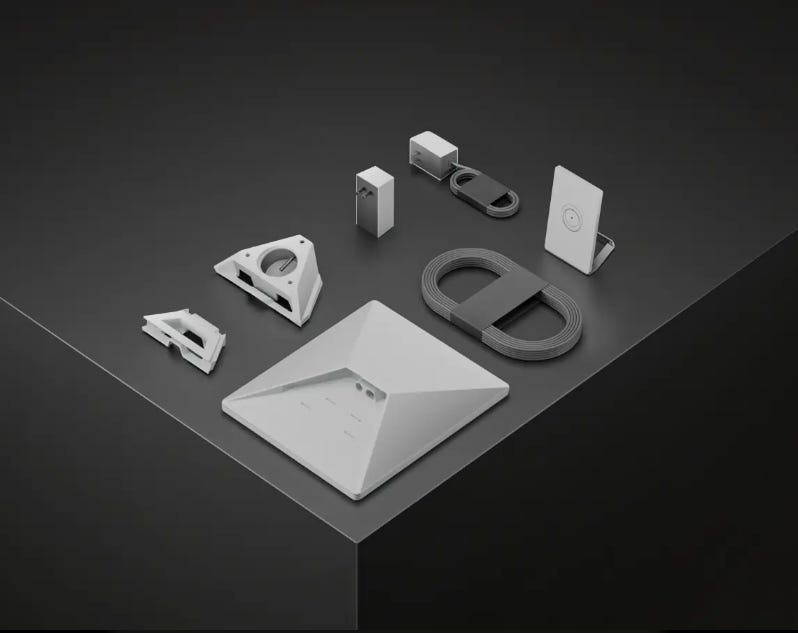
The Starlink support service actually writes about all this in its Knowledge Base. Of course, each Starlink user has the opportunity to order the appropriate cable and Wi-Fi router Starlink Mini (UTA-231) additionally, directly in the Starlink online store. But from the point of view of covering all customer needs, the creation of such a kit looks like a very wise step on the part of SpaceX.
At the time of publication of this material, the new Starlink Mini X kit is available for order only in Argentina. But of course, very soon we will see its availability in other regions of the planet.
The support of paid subscribers of SkyLinker.io will allow us to share even better and even more independent analytics, interesting reviews, and produce training and educational materials. From an inexpensive subscription costing a few cups of coffee per month to a more significant “Patron” level — all of this is clearly and qualitatively converted into information and knowledge, primarily for the defenders of Ukraine.
All the most interesting things from the world of communication and space technologies are also available in the form of educational audio podcasts and video lectures both on the website and on the SkyLinker Youtube channel.
What are all models of Starlink terminals available, and how can one avoid getting confused by them?

One feature of Starlink’s development over the last four years is the unprecedented dynamic of changes to satellite terminals. We are talking not only about sometimes more than daily software updates, new tariffs, changes in services, etc. Every year, new models, versions, and revisions of the Starlink terminals themselves appear, as well as WiFi router…
Starlink Ends Support for 1st-Generation Wi-Fi Routers

In November 2025, Starlink began notifying customers about the end of software support for the first-generation UTR-201 router, which was used together with 1st- and 2nd-generation terminals — the round UTA-201 and UTA-211.
Starlink 2025–2026: The Path to Global Hegemony

The year 2025 became the moment when Starlink finally established itself not merely as “the largest satellite constellation in the world”, but as a global communications infrastructure system. No longer a startup, not an experiment, not an “alternative for remote areas”
Starlink Onboard Terminals - Ukrainian Engineering Experience

Starlink satellite terminals are a high-tech system that is actively used in many mobile solutions, including all types of drones (UAV, USV, UGV). Maintaining stable communication while moving is quite a challenging task. Starlink developers not only incorporated the relevant functionality into their system during the development stage. They actually performed a gigantic amount of engineering work. But their high-tech result still has certain features and limitations.