

Anyone who has lost a satellite link at the worst possible moment knows that in war a satellite link is now fought over as fiercely as high ground. The United States is turning that contest into a standing global capability.
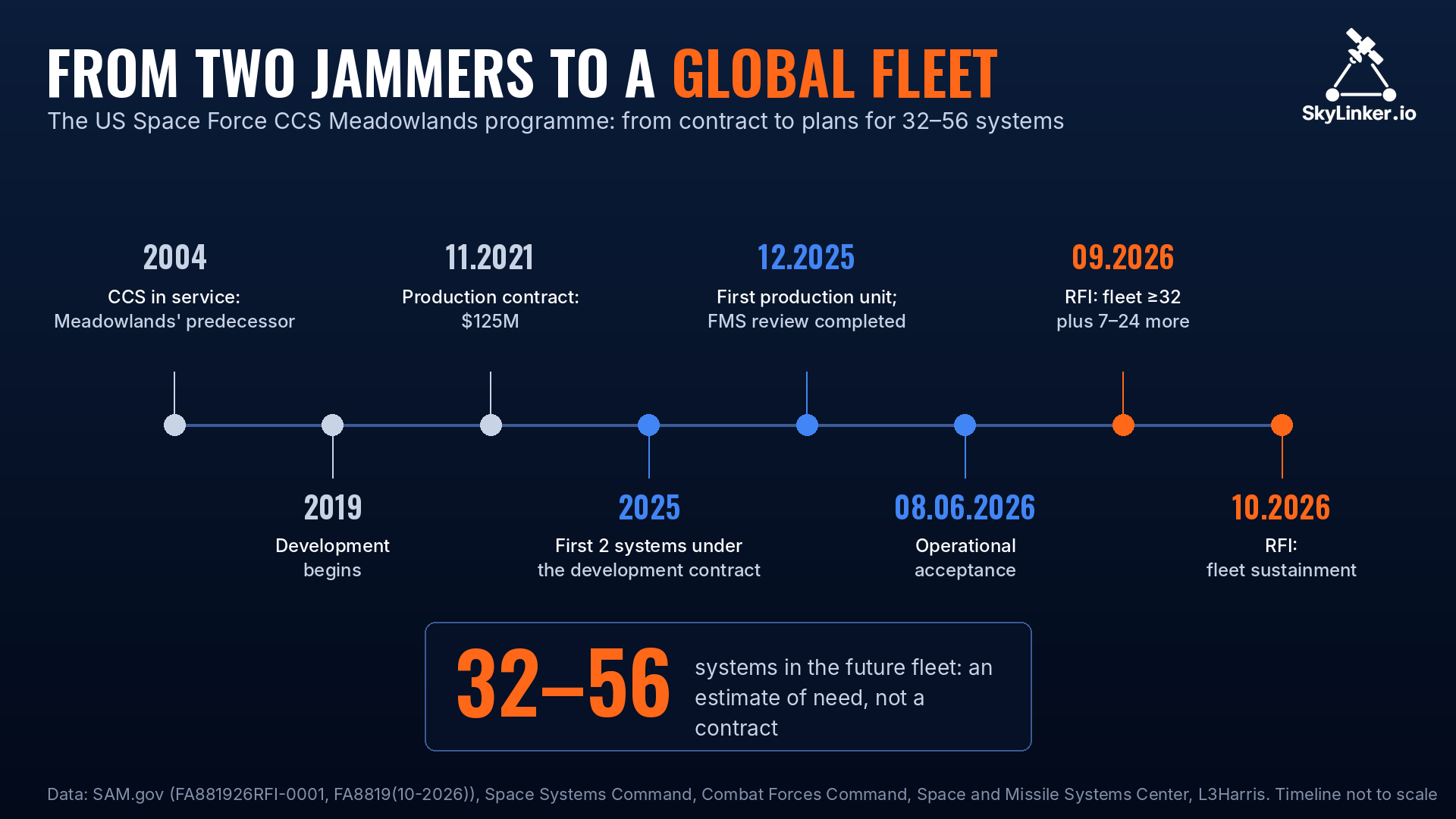
On 15 October 2026 the US Space Force’s Space Systems Command began looking for a contractor to sustain its Meadowlands ground-based satellite communications jammers. According to a September notice, the fleet will number at least 32 systems, and with a possible follow-on purchase, by our count, up to 56. Our assessment: the main target of these systems is the geostationary communications of US adversaries, not modern broadband constellations in low Earth orbit (LEO), although the documents never say so outright.
From CCS to Meadowlands: twenty years of one idea
Meadowlands is a deep upgrade of the Counter Communications System (CCS), a ground-based system for jamming satellite communications that the US military has operated since 2004, when it fielded the first version. The idea has not changed since. A ground station with a large antenna and powerful amplifiers beams interference at an adversary satellite, which then relays noise instead of useful signal. The effect is reversible: switch the transmitter off and the link is back, the satellite unharmed.
CCS was bulky. Meadowlands, according to an announcement by the US Space Force’s Combat Forces Command, is lighter, more compact and easier to transport than the CCS 10.2 it replaces. The main innovation is remote control: according to the manufacturer, L3Harris, a single operator can now run more simultaneous jamming missions than before, without having to stand next to the antenna.
The programme took seven years: development, according to L3Harris, began in 2019, and on 8 June 2026 the system was formally accepted for operations. In 2021 L3Harris won a $125 million production contract; it delivered the first two systems under the development contract in spring 2025 and the first production unit that December. The key milestones are shown in the timeline below. In December 2025 L3Harris also completed the international review required to sell the system to foreign militaries through Foreign Military Sales (FMS).
Meadowlands is not the only such system. According to Lt Gen David Miller, commander of Space Operations Command (as reported by Air & Space Forces Magazine), the Space Force is buying more than 150 small, remotely operated Remote Modular Terminal (RMT) jammers. There is also Bounty Hunter, a system that detects interference sources and locates them.
