

Until now, using Iridium satellite connectivity meant a dedicated proprietary modem and a proprietary protocol. On 17 November 2026 the company switched on its Iridium NTN Direct service: from now on its constellation of 66 LEO satellites can be reached by a ‘simple’ Narrowband Internet of Things (NB-IoT) module. That is the same kind of module often found in trackers and meters, and not a single new satellite had to be launched for it. For now there is one certified module, and Nordic promises wider access with a firmware update in January 2027.
We look at what is genuinely new, where the marketing runs ahead of the facts, and why without GNSS – Global Navigation Satellite Systems – such a device stays silent.
From the Qualcomm setback to a band of its own in 3GPP
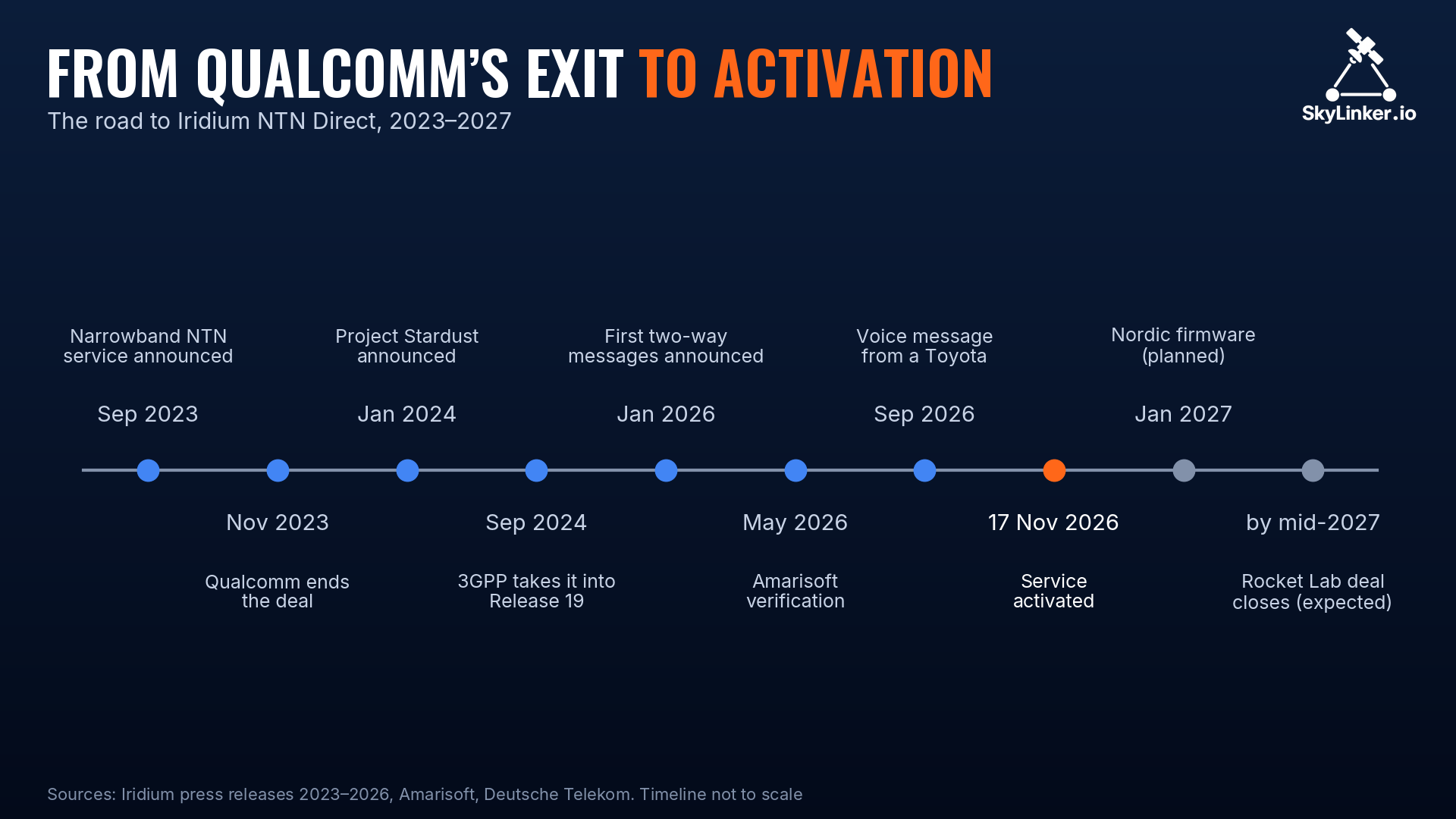
In November 2023 Qualcomm ended its agreement with Iridium on satellite messaging for Snapdragon smartphones. The technology was developed and demonstrated, but no smartphone maker put it into its handsets. The bet on a proprietary protocol in mass-market devices did not pay off.
Iridium had announced a narrowband service for Non-Terrestrial Networks (NTN) as early as September 2023, and after the break with Qualcomm it became, in our assessment, the company’s main bet. The logic is simple: if manufacturers do not want someone else’s protocol, the protocol has to become theirs. In January 2024 Iridium announced Project Stardust, and in September 2024 the 3rd Generation Partnership Project (3GPP), the consortium that writes mobile standards, accepted Iridium’s proposal as a work item.
The actual work then went into Release 19, the next package of standards; how exactly 3GPP reached space is covered in our piece on the road from 1G to NTN.
In that same press release, Iridium chief executive Matt Desch said: ‘we don’t have to be first, but we have to be the best’. Earlier in the very same release the service was already promised as the ‘world’s first truly global’ one. Modesty and the claim to be first somehow shared a page, but two years later the claim to be first won after all – the headline of the 17 November 2026 release reads ‘World’s First’.
In January 2026 Iridium announced the first two-way messages on air from a Nordic nRF9151 module. What mattered in that release was the method: the service was activated by a software update to the constellation itself. Iridium’s satellites are software-defined, so the new waveform was uploaded from the ground.
What went live on 17 November
Iridium NTN Direct is a satellite NB-IoT and direct-to-device (D2D) service built on 3GPP standards. NB-IoT is a narrowband mobile standard for sensors and trackers: it sends little data but uses energy sparingly. The service runs over Iridium’s 66 satellites in Low Earth Orbit (LEO) in the L-band. The company claims 100% global coverage.
The press release lists the uses: watches and emergency messaging, cargo and fleet tracking, vehicles, agriculture, meters and industrial monitoring. Among the partners is Nofence, which is building the service into its N3 livestock collars. Its vice president of engineering mentions herds both on a Norwegian mountain pasture and on the open range in the United States, and promises to keep track of every animal without a single new tower.
The first certified module is the Nordic nRF9151. Nordic plans a public firmware update for January 2027; after it, nRF9151 units already in the field will be able to work with Iridium without new hardware. Altair is building the service into its ALT1350 and ALT1550 chips, and Mlink is testing its MS150-IR on air. The operators named as partners are Deutsche Telekom IoT and Vodafone IoT.
The most striking demonstration was with Toyota: a car fitted with an nRF9151 board and a Deutsche Telekom IoT SIM sent a voice message over Iridium’s satellites. The voice was compressed by Fraunhofer IIS’s NESC codec, which works at up to 1 kbit/s. The first words were ‘testing, testing, one, two, freeway’. A classic sound check, only with the audience in orbit.
There is small print, and the release states it plainly: coverage can be provided anywhere today, but initial availability varies, and the right to provide and use the service in each country depends on local law and provider conditions.
