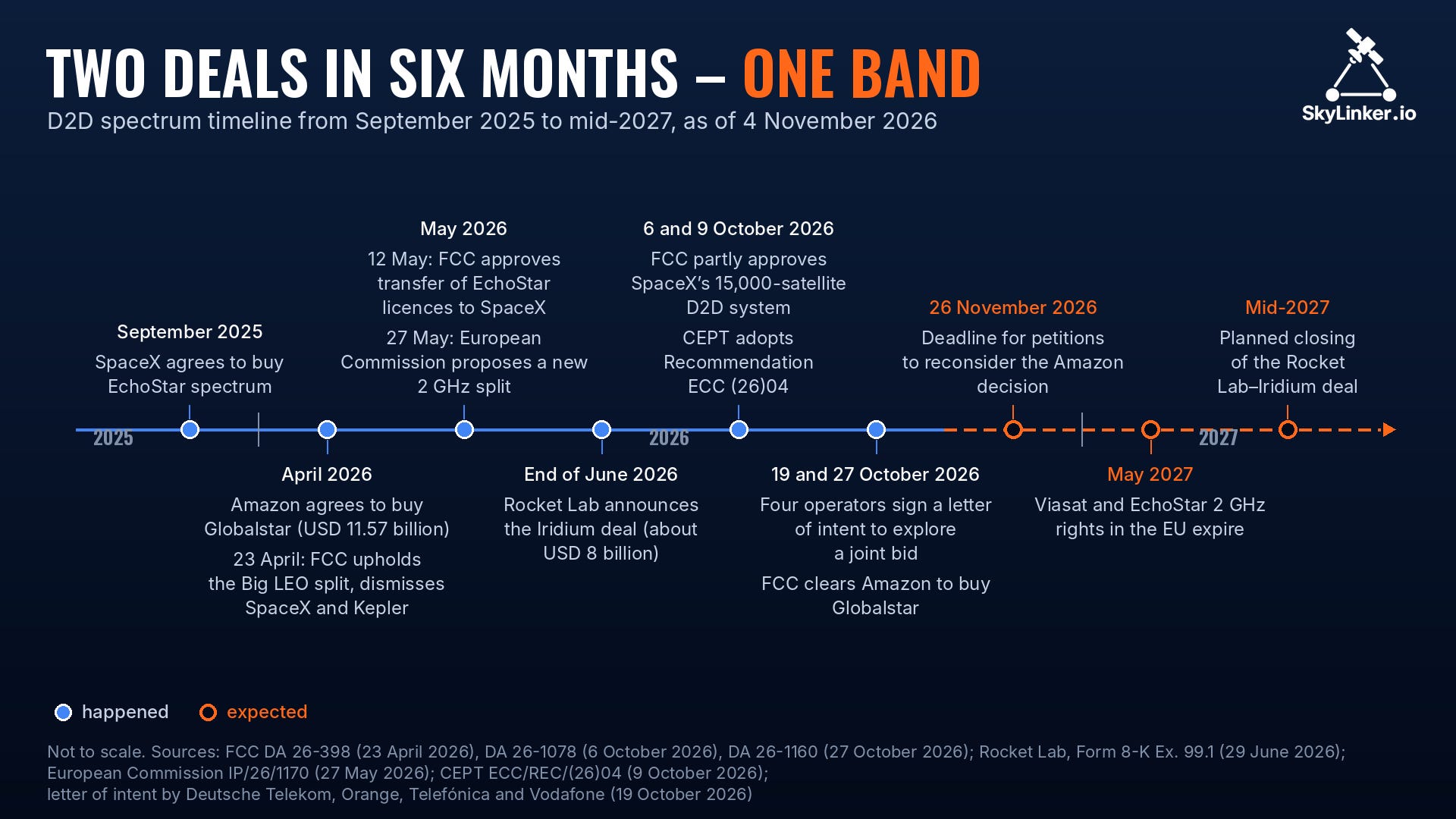
Satellite messaging on the iPhone – a feature owners recall only where the mobile signal gives out – runs on a small company called Globalstar. On 27 October 2026 the US Federal Communications Commission (FCC) cleared Amazon to buy it, together with the band of spectrum through which a satellite reaches an ordinary phone.
Add Rocket Lab’s pending purchase of Iridium, and both operators of the Big LEO band, which the US regulator split between just two companies back in 2007, are changing hands. In the United States that band is now closed to newcomers; over Europe its edges, and the EU’s own 2 GHz band, are still in play. Our assessment: in the satellite-to-phone race, who holds the frequencies, and on what terms, now matters as much as who launches the most satellites, so the new owners will fight not for the band but for subscribers and handset makers – against SpaceX, AST SpaceMobile and, in Europe, the mobile operators weighing a joint bid. The full decision: FCC, DA 26-1160.
A note from the author. This piece relies on published regulatory decisions, EU institutions’ documents and company filings; some details from trade media are attributed in the text. I deliberately neither assess nor comment on how these changes might affect specific communications systems used by Ukraine’s Defence Forces.
One band, two buyers
In April 2026 Amazon agreed to buy Globalstar for USD 11.57 billion in cash or Amazon shares. At the end of June Rocket Lab announced a cash-and-stock deal for Iridium that values it at roughly USD 8 billion. The parties expect to close in mid-2027.
Both targets provide Mobile-Satellite Service (MSS): connectivity for handsets, trackers and sensors without a large antenna. Both operate in what the United States calls the Big LEO band, 1610–1626.5 MHz and 2483.5–2500 MHz. The FCC had expected several systems there; only two were built, and in 2007 it split the band between them.
The band’s value lies in physics: lower frequencies lose less energy along the path, so at 1.6 and 2.4 GHz a satellite can close a link with a smartphone’s tiny antenna and no extra hardware, as long as the phone supports the band. That band, in the FCC’s finding, is precisely what Amazon lacked. The result is direct-to-device (D2D): a satellite channel on an everyday phone. A related approach that reuses a mobile operator’s own frequencies is explained in What is Direct-to-Cell from Starlink.
The buyers have exactly one thing in common: what they lack. Amazon is deploying Amazon Leo, a broadband constellation in low Earth orbit (LEO), but has no spectrum for phones. Rocket Lab launches rockets and builds satellites but holds no MSS spectrum at all. So both are buying spectrum rights and a customer base more than satellites.