

A few days ago, global media reported a fairly significant event for the satellite communications system of the aggressor state — the complete loss of an important, relatively modern, and powerful telecommunications satellite. SkyLinker has prepared a brief overview of the incident and an analysis of its consequences.
Incident in orbit
On March 4, 2026, at approximately 8:45 a.m. Moscow time, the geostationary satellite Express-AT1 (orbital position 56° East longitude) experienced a sudden failure — an instantaneous shutdown of all systems for unknown reasons. The operator, FSUE “Kosmicheskaya Svyaz” (GP KS / RSCC), reported an “abnormal situation.” All attempts to restore the satellite have failed.
At present, no details or causes of the incident have been reported in the media. Therefore, the specifics of the malfunction and the current state of the satellite’s systems remain unknown. However, the very fact that the satellite has been officially declared lost confirms that Express-AT1 is completely out of service. It is also unknown whether the Russian side still has the capability to control the satellite’s orbit or whether it can move it into a graveyard orbit.
About the Express satellite constellation
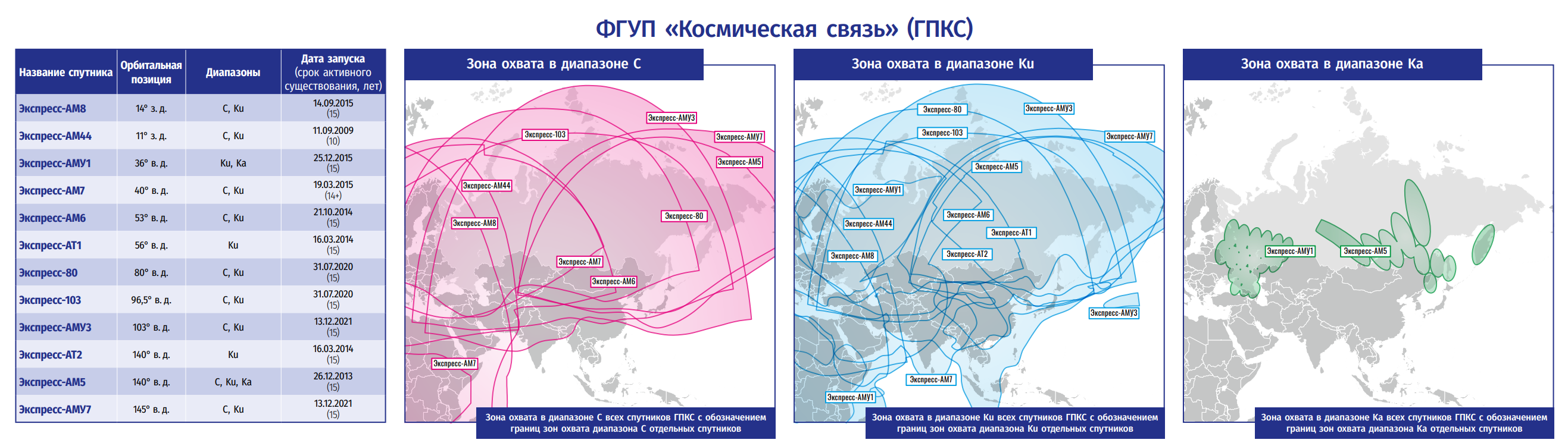
The “Express” constellation is the primary geostationary system of civilian communications satellites of the so-called Russia, operated by the state operator RSCC (GPKS). It consists of several series of spacecraft — primarily Express-AM, Express-AMU, Express-80/103, and Express-AT — positioned at various orbital slots above Eurasia. These satellites operate in the C, Ku, and partly Ka bands, providing television and radio broadcasting, broadband satellite internet, corporate VSAT networks, trunk communication channels, and media content distribution across the territory of the former USSR and adjacent regions. In the current configuration of the constellation, satellites of the AM and AMU series serve as the main infrastructure platforms for broadband connectivity and operator networks.
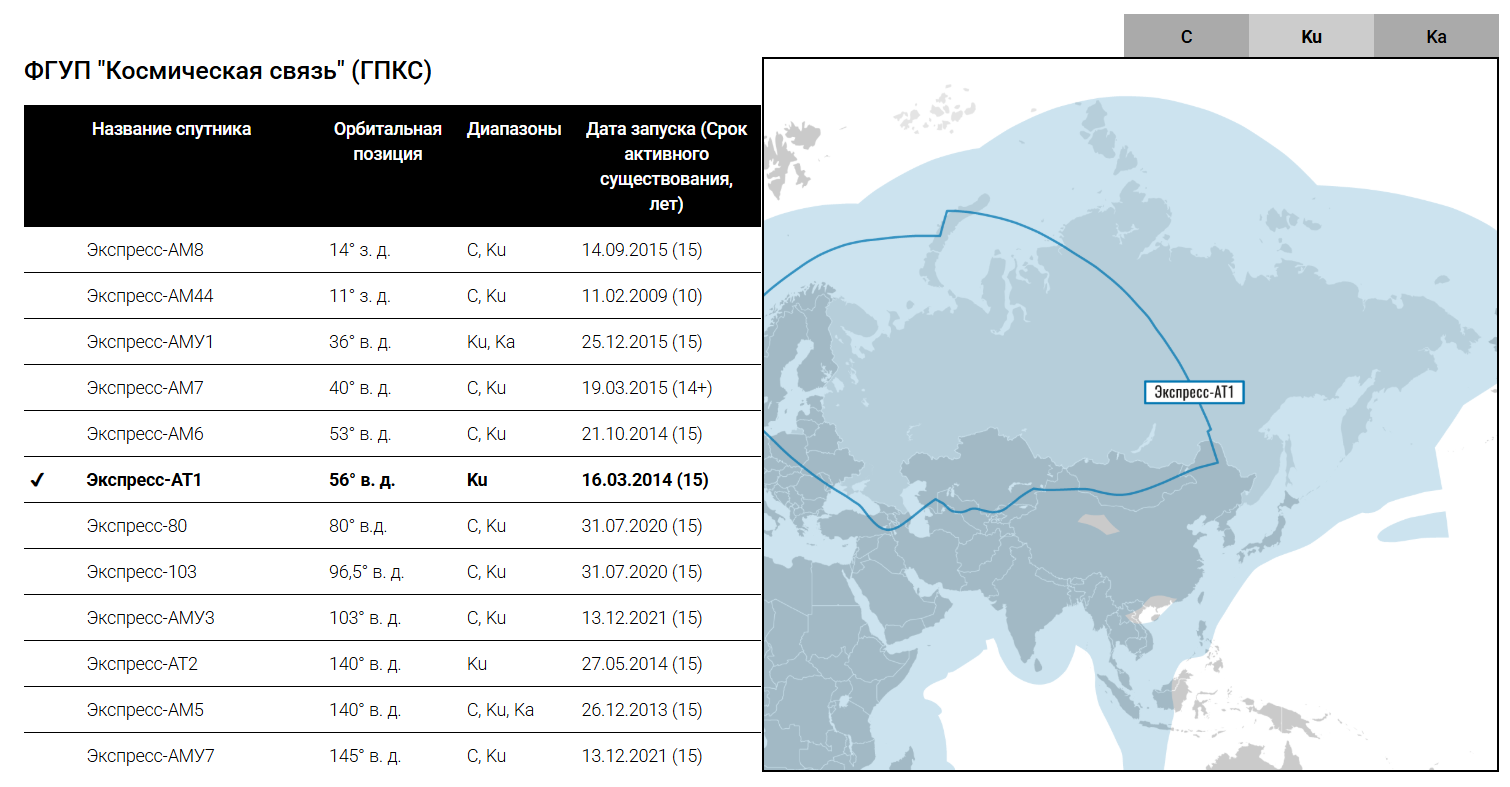
The satellites Express-AT1 and Express-AT2 occupy a more specialized role within this system. They are Ku-band spacecraft deployed at orbital positions 56°E and 140°E respectively, and were created primarily for DTH (Direct-To-Home) satellite television services and signal distribution. Because of this, their role in the Express constellation is not to form the backbone infrastructure for satellite internet, but rather to provide regional coverage and transponder capacity for broadcasting and certain Ku-band services. In practice, they complement the system’s main communications satellites by expanding the available spectrum and orbital positions.
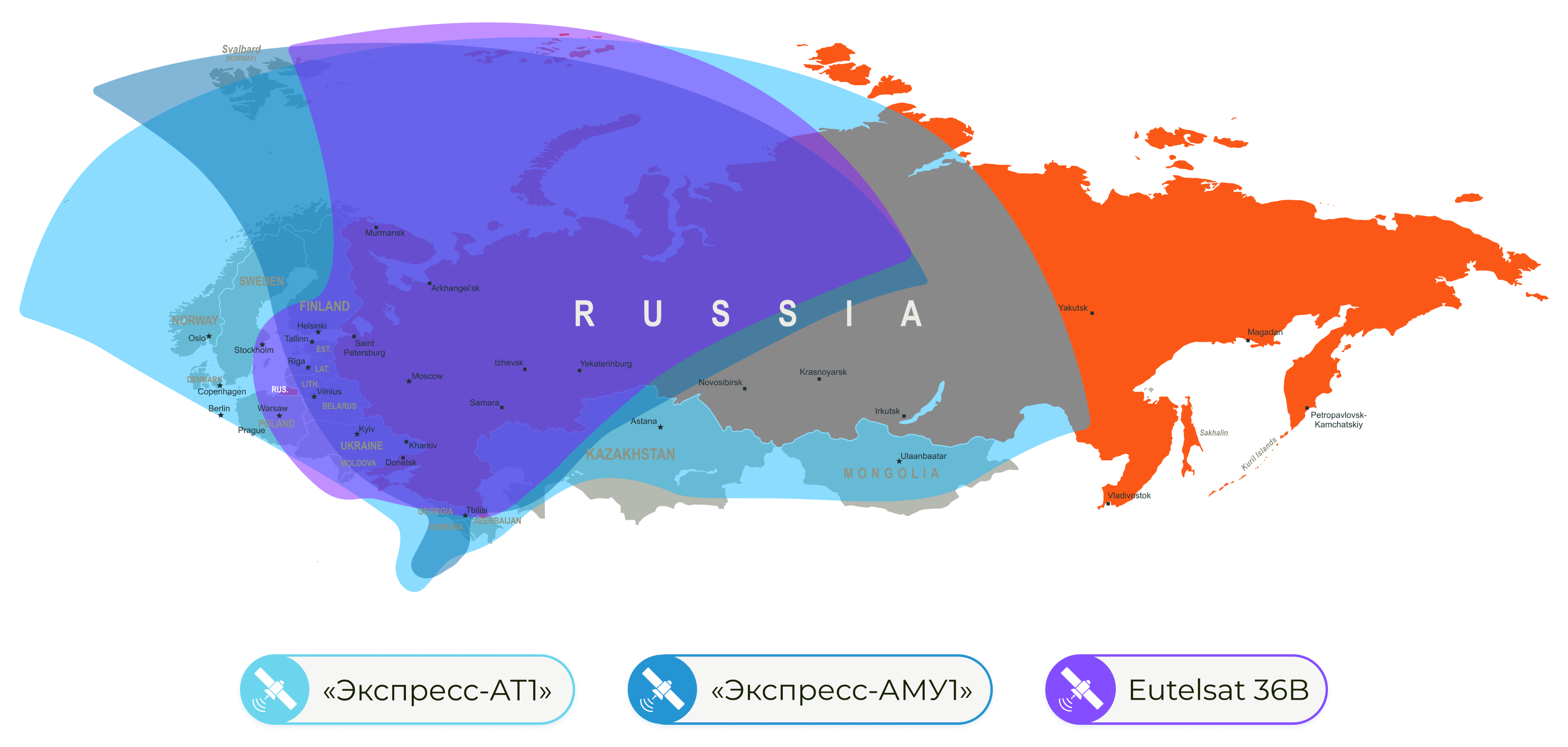
In the geographic distribution of roles, Express-AT1 is oriented toward the European and central part of the so-called Russia, while Express-AT2 mainly covers Siberia and the Far East. Thus, the AT-series satellites serve as an additional Ku-band resource within the Express constellation, providing regional coverage and support for broadcasting services, while the main load of broadband satellite communications in the system is carried by spacecraft of the AM and AMU series.
About the Express-AT1 satellite
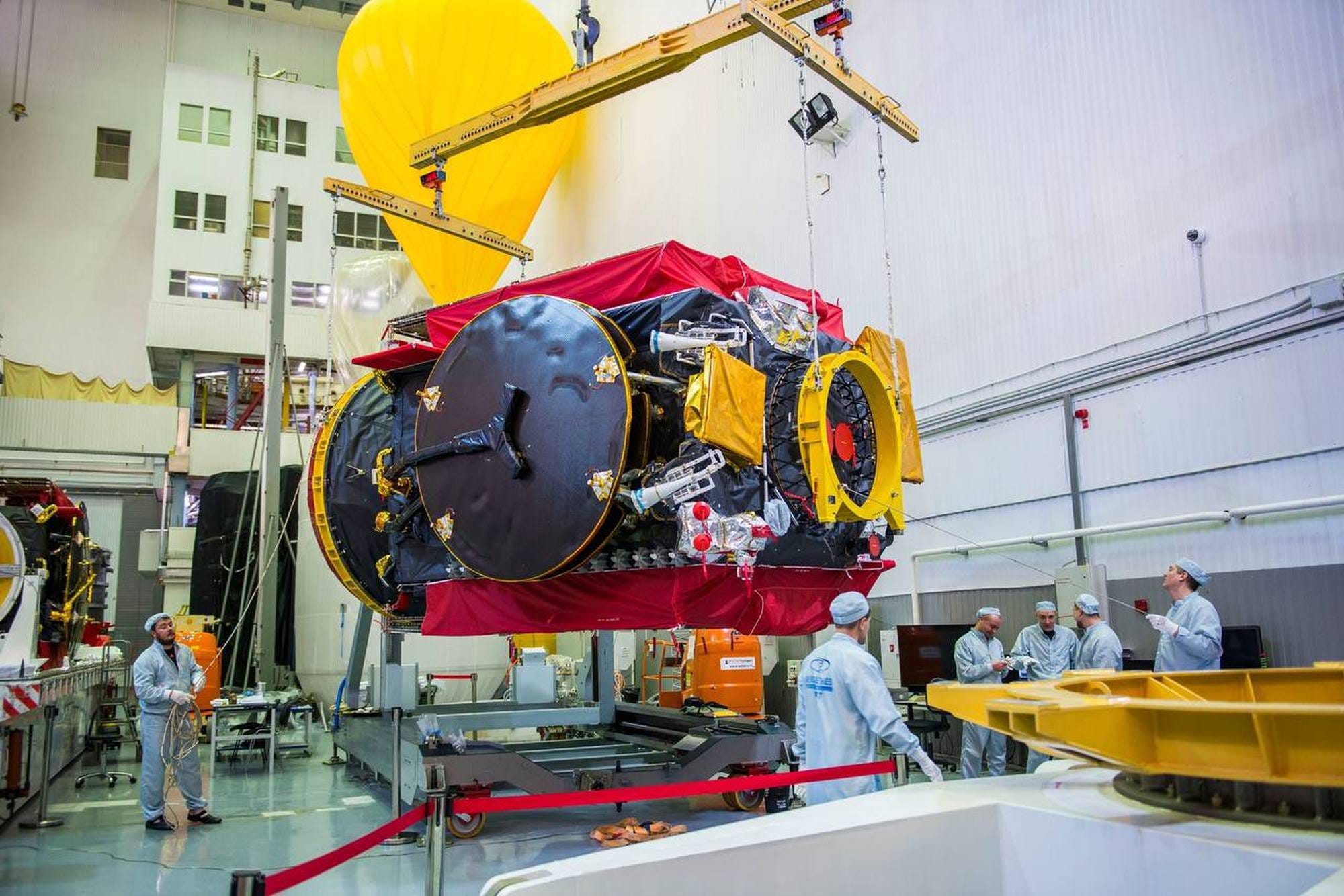
The Express-AT1 satellite was created as part of the modernization of the Russian geostationary communications constellation implemented under the Russian Federal Space Program for 2006–2015. It was manufactured by JSC “Information Satellite Systems named after Academician M. F. Reshetnev” (ISS Reshetnev), the primary Russian manufacturer of communications satellites. The project was implemented in a format of international cooperation with Thales Alenia Space (France), which supplied a significant portion of the communications payload and several onboard systems.
The spacecraft was based on the Express-1000H platform — a modification of the Russian Express-1000 satellite platform developed by ISS Reshetnev for mid-class geostationary satellites. This platform forms the structural and power “framework” of the satellite: it includes the spacecraft structure, attitude control and stabilization systems, onboard electrical power systems with solar arrays, thermal control systems, orbit correction thrusters, and part of the onboard control system. In other words, the Russian side was responsible for the mechanical structure, power systems, propulsion, flight control system, and integration of the spacecraft.
The French company Thales Alenia Space mainly supplied the telecommunications payload. This included Ku-band transponders, power amplifiers, antennas, and a significant portion of the radio-frequency electronics that directly generate and transmit communications signals. In many satellites of the Express series from that period, this part of the equipment was based on French or broader European technologies, since they provided higher efficiency and reliability for telecommunications hardware.

Express-AT1
Launched on March 15, 2014
Entered service on April 22, 2014
Designed service life: 15 years (until approximately 2029–2030)
Mass: 1,726 kg
Payload power: ~5.88 kW (according to other sources 5.6–7.6 kW)
Payload: 32 active Ku-band transponders (+8 backup)
Orbit: geostationary, 56°E
According to its official positioning, Express-AT1 was primarily a satellite for direct-to-home (DTH) satellite television broadcasting. Even Eutelsat, under a 15-year contract, leased transponders on it for the Tricolor TV and NTV Plus platforms. In other words, originally and formally it was not a “military satellite,” but a “nominally civilian” high-power Ku-band resource that later began to be viewed as part of the broader dual-use infrastructure of the aggressor state.
Public confirmations of Express-AT1 being used for military communications have not yet appeared in the media. Non-public confirmations of such use remain in the “fog of war.” However, it should also be understood that even the “simple” broadcasting of television channels of the aggressor state is unquestionably part of its information warfare and an element of psychological and information operations.
Technologically, the Express-AT1 satellite makes it possible to provide two-way broadband HTS access to the Internet or service networks for subscribers using typical VSAT equipment. This includes both the familiar satellite dishes with diameters up to 1.2 meters and newer flat-panel terminals with phased-array antennas.
The connection throughput that the Express-AT1 satellite can provide for such equipment: 1–10 Mbps uplink and 10–50 Mbps downlink, using the DVB-S2 / TDMA standard.
Consequences of the incident
The main consequence of the loss of Express-AT1 was the decision to relocate the orbit of the satellite Express-AT2 from 140°E to 56°E, which may take 3–6 months. Naturally, this will also “expose” the eastern region that was previously covered by Express-AT2.
Until the relocation is completed, DTH subscribers of Express-AT1 have no means of restoring services without re-pointing antennas and reconfiguring equipment.
Taking advantage of the situation, the company Eutelsat terminated its 15-year contracts for leasing capacity on Express-AT1/AT2, citing the loss of those capacities. For Eutelsat, these are relatively minor commercial losses while eliminating reputational risks associated with cooperation with the aggressor state. For the so-called Russia, however, this means both the loss of some of the few remaining sources of financing for the satellite constellation and a fairly significant structural change in its service portfolio.
For the satellite communications system of the aggressor state, the loss of Express-AT1 does not currently appear critical. However, against the background of the loss of the ability to use Starlink in the territory of Ukraine, the loss of communications for any number of users in occupied territories is unquestionably viewed positively.
The very fact of limiting the aggressor state’s capabilities for conducting military operations, where satellite communications play a key role, is quite significant. Against the backdrop of the aging current fleet of communications satellites, the failure of each modern satellite is a strategically important incident.
The support of paid subscribers of SkyLinker.io will allow us to share even better and even more independent analytics, interesting reviews, and produce training and educational materials. From an inexpensive subscription costing a few cups of coffee per month to a more significant “Patron” level — all of this is clearly and qualitatively converted into information and knowledge, primarily for the defenders of Ukraine.
All the most interesting things from the world of communication and space technologies are also available in the form of educational audio podcasts and video lectures both on the website and on the SkyLinker Youtube channel.
OneWeb Won’t Forget Russia’s Space Heist

In the spring of 2022, the OneWeb story looked like yet another episode in the chain of ruptures between the so-called Russian Federation and the West in the space sector. The aggressor state effectively stripped OneWeb of its satellites and of the money already paid for their launch. However, today the propagandistic and loud statements made by Kremlin…
Ukrainian Satellite Communications: Plans Becoming Reality

There is probably no one left today who is unaware of Starlink and its role in Ukraine’s successful defense against the aggressor’s invasion. High-speed satellite communications have transformed the battlefield, ushering in the era of “Drone warfare.”
How Recent Space Weather Events Have Affected Our Satellites?

Many people are aware that space weather has a significant impact on our communications. We have written about this in more detail before. However, beyond the various effects on radio wave propagation through the atmosphere, it is important to understand how space weather affects satellites and entire satellite constellations. Is this a real threat? Or …
DARPA Blackjack: A Flexible and Cost-Effective Military LEO SatCom

The Crisis of the Classical Space Paradigm
Verification of Starlink in Ukraine - achievements, shortcomings, conclusions

More than a month has passed since Ukraine implemented regulations that made it possible to deprive the enemy of the ability to use Starlink on the territory of Ukraine. This indeed became a landmark event that influenced the course of military operations.