

In recent days, the news feed has been flooded with all kinds of headlines like “Starlink was shut down in Iran,” “The regime learned how to jam satellite internet,” “Starlink is broken,” and other similar nonsense. Naturally, many journalists and media outlets were happy to exploit clickbait headlines. As a result, many people perceived this narrative as an actually documented fact. Understandably… when such claims are published by well-known media, they surely cannot be false, right?
Author’s note: Spoiler — they can. And unfortunately, very often they are… That is why fact-checking, evidence, or at least critical thinking help prevent drifting away from reality.
That is why I decided to publish my own authorial analysis of the situation and its sources, in order to provide an opportunity to better understand what is going on, and at the same time to convey certain technical aspects that should be taken into account in the future by many — from journalists to decision-makers: managers, officers, congressmen, senators, and so on.
Is Starlink even available in Iran at all?
To begin with, a small historical excursus is needed, one that is absolutely essential for understanding the background of the situation. Satellite receivers have been prohibited by law in Iran since 1994. Therefore, everything that operates there does so illegally.
After the protests of 2022, Elon Musk wrote on X (then still Twitter): “Starlink is now activated in Iran.” Since then, the number of Starlink terminals in the country has been growing and, according to various estimates, has reached several tens of thousands.
That said, there were periods when the Iranian regime attempted to “deal with” this — and possibly succeeded in some places. After the protests in June 2025, the story repeated itself. Elon Musk once again “tweeted” (already on his own platform X): “Beams are on.” After that, the regime fully “tightened the screws” and began applying the death penalty to Starlink users, treating them as spies.
And quite recently, media reports emerged about SpaceX providing free access to Starlink for all users on the territory of Iran. There is already considerable confirmation of this directly from Iranian Starlink users.
This is what the condensed history of Starlink in Iran looks like — unofficial mass access through smuggling routes for the equipment. Where anyone caught “red-handed” by the government risks their own life…
What happened to the Internet in Iran in January 2026?
In connection with the protests that began on December 28, 2025, the Iranian regime predictably decided to “flip the internet kill switch.” A classic and complete national telecom shutdown took place. The Internet, mobile networks, providers, international links — all of it went down. And this was clearly visible on the status panels of various global monitoring services.
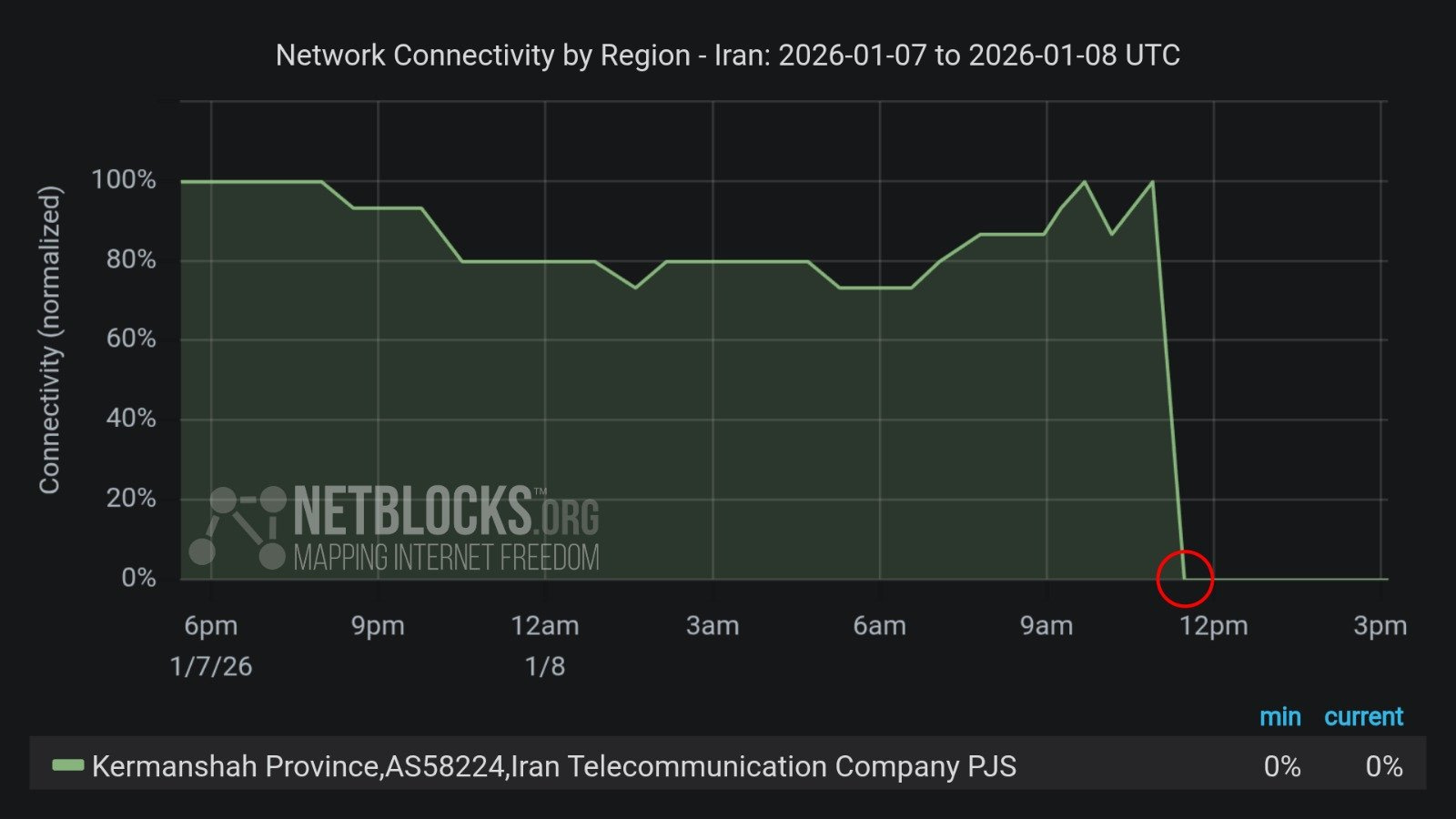
On January 8, 2026, at approximately 18:00 local Iranian time, national internet traffic dropped to 1% of its normal level. This was reported by the independent monitoring organization NetBlocks. On January 13, this was confirmed by a publication on the Cloudflare Blog.
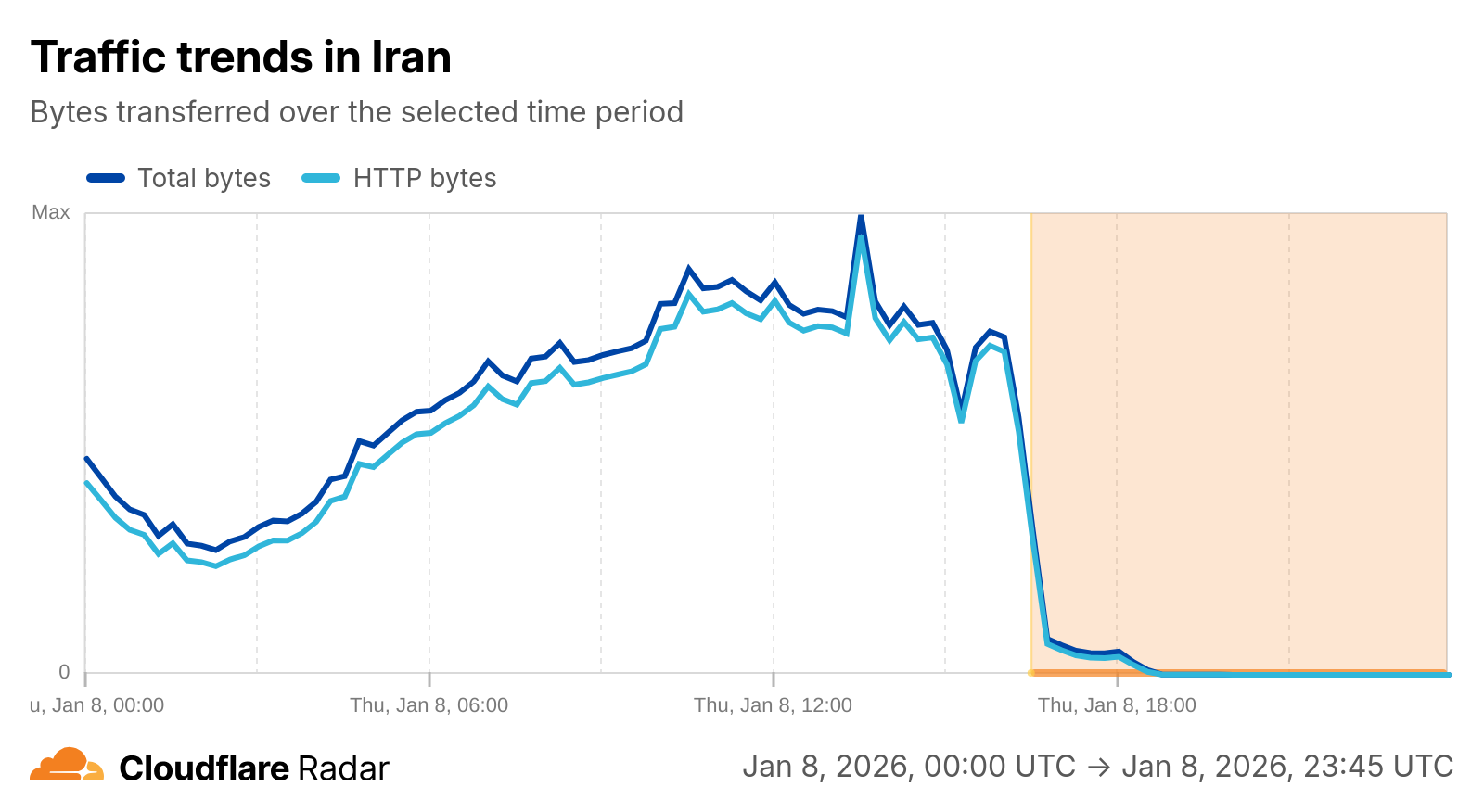
At present, the shutdown continues, although there are some reports about partial restoration of access for certain pro-government Iranian resources and organizations.
So what happened to Starlink then?
Naturally, such widespread use of Starlink could not fail to attract the regime’s attention. Accordingly, all possible suppression measures were applied.
The first to report potential problems with Starlink was Amir Rashidi — Director of Digital Rights at the Miaan Group, an expert on the Iranian internet. His statements about “80% packet loss” (loss of Starlink data packets during jamming between January 8–10, 2026) are based on anonymous reports from users in Iran (his activist network), and first appeared in an interview on January 10.
In that interview, Rashidi interprets the problem as “something beyond GPS jamming” (likely mobile jammers, similar to those used by Russia in the war against Ukraine). A full quote from Rashidi: “I believe the Iranian government is doing something beyond GPS jamming, like in Ukraine, where Russia tried to jam Starlink. […] In some areas of Iran, there had been an 80% loss in packets.”
That is, he himself states that the 80% packet loss figure represents a peak in “hot protest zones.” But during further republication of his interview by other media outlets, a classic “broken telephone” effect occurred…
Author’s note: I am personally very familiar with this kind of situation assessment based on fragmentary data. And I cannot deny that sometimes it works for diagnosing certain problems and even finding solutions — occasionally even for scenarios of detecting and destroying enemy electronic warfare assets. But it is absolutely impossible to consider such data representative of an entire region and of all tens of thousands of Starlink terminals in Iran. And Rashidi himself never made such interpretations in his initial interview.
The next source for many media outlets was a tweet by NasNet. NasNet (or NASNET) is an Iranian informal community of activists and technicians dedicated to promoting Starlink as a censorship-circumvention tool in Iran. In some ways, it is similar to the Ukrainian Facebook community Narodnyi Starlink.
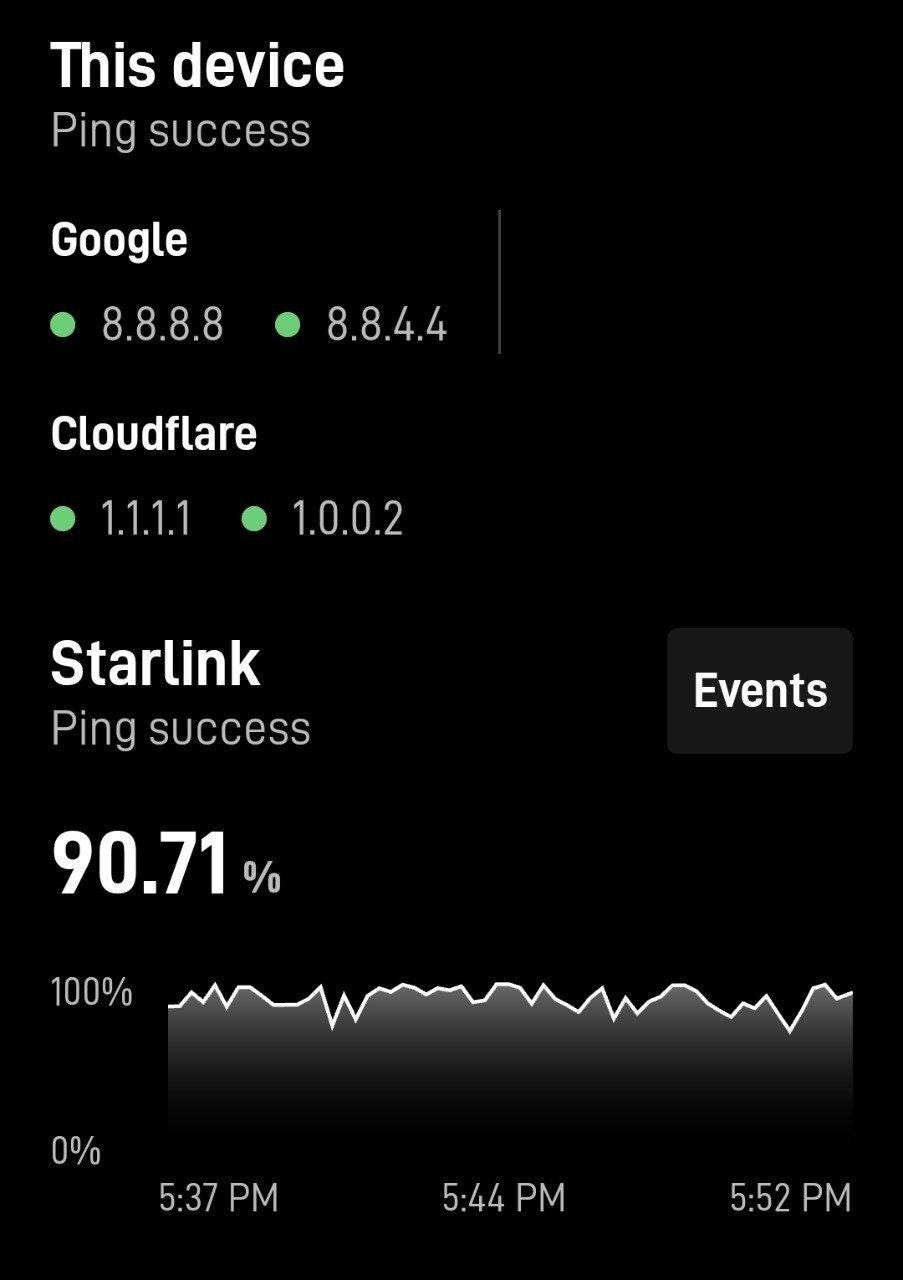
A translation of NasNet’s tweet from Persian contains an interesting statement:“Thanks to cooperation with the Starlink technical team, the situation with interference and packet loss in Tehran has significantly improved and decreased from approximately 35% to approximately 10%.”
From this, several immediate conclusions can be drawn:
The problem primarily concerned Tehran. Possibly also some other major cities, but by no means the entire territory of Iran, nor even a significant portion of it.
The efforts of the SpaceX team were most likely related to optimizing network operation under electronic warfare conditions and deploying optimized firmware for Starlink terminals in problematic zones. And these efforts were to some extent fast and effective.
The problem did not disappear completely, but became rather minor — more “simply unpleasant” than “critical.” That is, it was not and did not become global.
Author’s note: Yes, we carried out similar actions together with the incredible SpaceX team, both when we were just learning how to counter Russian occupation forces’ electronic warfare systems, and now. I can confidently confirm that both satellite network optimization and optimization of terminal settings delivered via software updates are indeed capable of helping in cases of electronic warfare application. And after reviewing NasNet’s posts, I can confidently say that I did not find any statements there about “global suppression of Starlink” — claims that some journalists effectively “stuck” onto them.
It is worth noting that NasNet publishes fairly up-to-date advice and instructions for Iranians who are forced to use Starlink terminals in guerrilla conditions, risking their lives. Their experience is worthy of attention and study. When I created my first manual for military Starlink users in 2022, which received a publicly available version in 2023, I had to operate under rather different conditions and risks. But certain parallels are very clear to me. It is quite interesting and useful to track their progress in strengthening the security of Iranian Starlink users. And from my side, I wish the NasNet team success in this difficult work. If an opportunity to help arises, I will be glad to do so..
Chronology summary:
08.01.2026
The Iranian regime initiates a nationwide telecom shutdown.
10.01.2026
Observations of partial problems with Starlink appear in Tehran and (potentially) some other major cities during January 8–10.
At the same time, confirmations appear of a reduction in these problems and improved Starlink performance thanks to the efforts of activist specialists and SpaceX engineers.
13.01.2026
Confirmations appear of free Internet access being provided to Starlink users in Iran.
14.01.2026
No confirmations of global failures or significant suppression of Starlink satellite communications have been found to date — despite loud headlines in many media outlets…
Is it even possible to suppress Starlink at all?
The experience of Russia’s armed invasion of Ukraine and nearly four years of large-scale Starlink usage demonstrates that technologies without flexibility simply cannot survive. From the very beginning, Elon Musk’s team embedded many critically important features into Starlink’s design. One of them is software-defined operation — the ability of all components — the network’s infrastructure core, satellites, and terminals — to flexibly change their operating parameters. This enabled SpaceX to effectively counter absolutely all attempts to suppress the Starlink network, whether via electronic warfare, cyberattacks, or other means.
Of course, design is only part of the solution. Without well-organized work by motivated and competent personnel, this would simply not be possible. Nevertheless, the fact remains that it was in Ukraine that SpaceX gained unique experience in confronting perhaps the strongest adversary in cyberattacks and electronic warfare — the so-called Russian Federation and its allies, among which Iran is included.
It was Russian anti-satellite electronic warfare systems that for many years were used as a scarecrow even by far-from-pro-Russian media. But reality turned out to be different — not a single case of significant and confident suppression of satellite communications on the battlefield was demonstrated by Russian electronic warfare systems. That is, even when some degree of success was achieved, SatCom industry engineers always found effective countermeasures, and even partial success quickly became a closed chapter. Starlink was no exception.
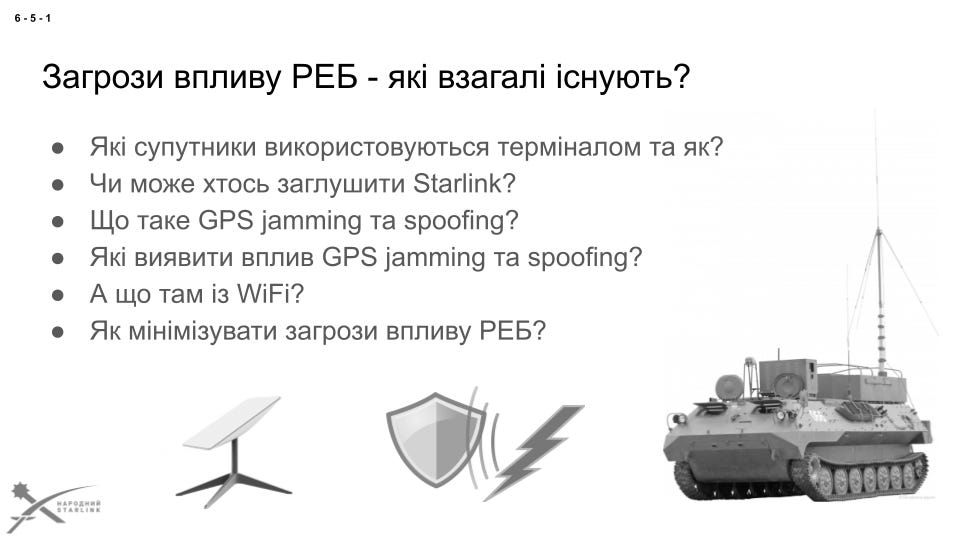
The year 2023 became particularly active in terms of the development by Russian specialists of various new electronic warfare systems specifically against Starlink — both at the tactical and operational levels. In the spring of 2024, under the “cover” of the strongest geomagnetic disturbance caused by solar activity in the last 25 years, the Kremlin even deployed a rather expensive and complex system with a very “stellar” name. However, even in the areas of its highest effectiveness, it still achieved very insignificant results — connectivity continued to function. And the physical necessity of placing this system in close proximity to the battlefield led to a very short life cycle…
If such systems were to suddenly end up in Iran — which is quite doubtful — their detection, identification, and destruction would in fact be a fairly simple task both for the armed forces of the United States and its allies, and for the Israeli Air Force. These are rather bulky targets that are easy to detect and destroy.
Of course, in various media we can see claims about the capabilities of certain stationary networks, gigantic swarms of drones, space lasers, constellations of specialized satellites, and even “space trucks” carrying “metal shrapnel”… But all of these means are either still hypothetical, or exist only as very expensive “cardboard” prototypes. And all of them come with budgets that are very easy to digest, with very appetizing numbers of zeros in their price tags… That is, it is rather difficult to call them close to real-world implementation.
To summarize: neither on the battlefield in Ukraine, nor anywhere else, has anyone yet demonstrated even any noticeable success in suppressing low Earth orbit (LEO) satellite networks.
Author’s note: Of course, an attentive or meticulous reader will note that here we are dealing with a situation of my assertions versus the assertions of certain media outlets or individuals. Therefore, I will simply say this — if someone claims to you that somewhere the Starlink network or other LEO solutions have been suppressed, demand evidence. Over the past four years of very deep daily immersion in everything related to Starlink, satellite technologies, and electronic warfare systems, I personally have not seen such cases.
Why are Starlink and other LEO networks so resilient?
The answer is very simple — the laws of physics plus scale. When thousands of satellites are flying above you — meaning that wherever you are, you always have direct line of sight to at least several satellites of one LEO network or another — you can always switch between them.
Now recall that in the case of LEO constellations, satellites fly along different orbits, crossing the sky above you from horizon to horizon in 3–5 minutes. And if you use a kind of radio “flashlight” for communication with each satellite — a narrow beam directed at the satellite — then the ability to effectively interfere with your operation is limited exclusively by the technological vulnerabilities of the system itself. And in modern, software-defined systems, including Starlink, OneWeb, Amazon LEO, and others, there is a good ability to quickly reconfigure parameters so that any vulnerability, if it even exists, can be rapidly eliminated and fixed.
Of course, there are certain “narrow points” — a problem must be detected and identified, and a solution must be created, tested, and delivered. But just look at who has what experience in this “cat-and-mouse” game. Compare the experience of teams like SpaceX, Eutelsat, Amazon, and similar ones with the experience of their adversaries’ teams.
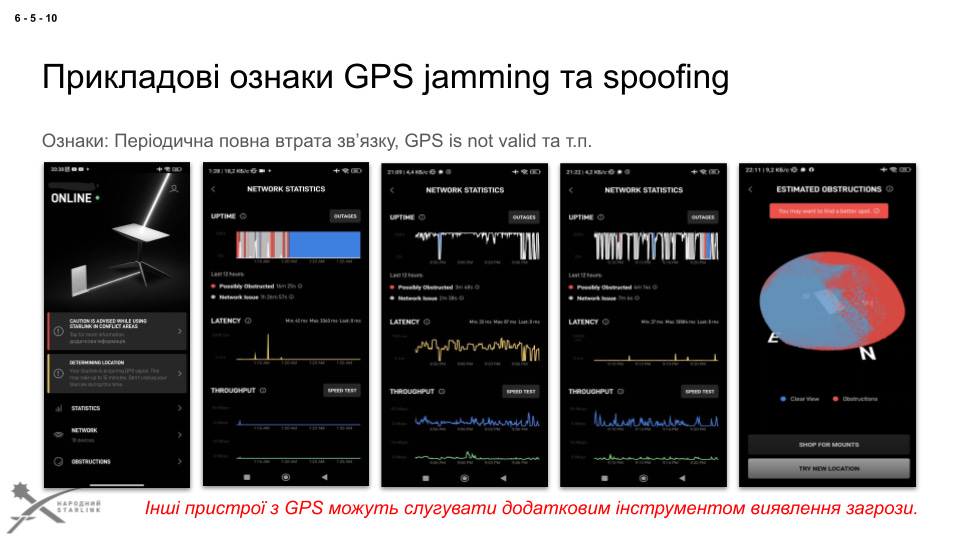
A simple example: to continuously solve space geometry problems, every Starlink terminal or other LEO system terminal needs to know its precise coordinates. This is required to hit a rapidly moving satellite with a narrow radio beam. Until recently, Starlink terminals depended on GNSS (GPS, Galileo, etc.) for this. That is why Starlink terminals were vulnerable to GNSS jamming or spoofing. They were…
Now Starlink can already use its own PNT system (Positioning, Navigation, Timing) instead of GNSS. All it needs for this is the appropriate software. Which is exactly what we see in the improved resilience of Starlink in Iran after software updates.
Thus, years of effort by the “cat,” with significant expenses on equipment, implementation, and specialist training, are easily “crossed out” by a much simpler and cheaper software update on the terminals and satellites of the “mouse.” Of course, this is a simplification, but it clearly demonstrates the essence — in this particular game, Starlink has substantial advantages.
As for the capabilities of detecting and localizing Starlink terminals, it is worth not missing our publication “Can enemies detect Starlink?”, and also not forgetting “Thermal Signature of Satellite Communication Terminals - The Experience of Modern Warfare”, as well as “The Wi-Fi Footprint – a little-known yet critical unmasking factor in this war”.
Conclusion
Situations where the problems of high-tech and space solutions are poorly understood, yet are very easily inflated into something big and frightening, have always been numerous. The overwhelming majority of journalists from quite respectable media outlets could not resist the temptation to write about “global problems with Starlink,” and so on. And after them, the majority of decision-making managers and officers also perceived these publications as truthful.
It happened. It is happening. And it will probably happen again.
Nevertheless, for SkyLinker, it is important to call things by their proper names, adhere to the principles of critical thinking, and provide balanced and verified information. To provide correct information primarily to the professional community, but also to those readers who are simply interested in staying on the cutting edge of high and space technologies without losing touch with reality — in plain language, with appropriate explanations and references.
Author’s note: I hope we succeeded this time — and will succeed next time as well 🙂
I sincerely thank everyone who supports SkyLinker with a paid subscription — this is vital for us. Everything that SkyLinker can currently offer its readers, listeners, and viewers depends not on clickbait headlines, advertisers, or sponsors, but precisely on you — genuinely interested subscribers of SkyLinker.io.
Volodymyr Stepanets
The support of paid subscribers of SkyLinker.io will allow us to share even better and even more independent analytics, interesting reviews, and produce training and educational materials. From an inexpensive subscription costing a few cups of coffee per month to a more significant “Patron” level — all of this is clearly and qualitatively converted into information and knowledge, primarily for the defenders of Ukraine.
All the most interesting things from the world of communication and space technologies are also available in the form of educational audio podcasts and video lectures both on the website and on the SkyLinker Youtube channel.
Starlink Onboard Terminals - Ukrainian Engineering Experience

Starlink satellite terminals are a high-tech system that is actively used in many mobile solutions, including all types of drones (UAV, USV, UGV). Maintaining stable communication while moving is quite a challenging task. Starlink developers not only incorporated the relevant functionality into their system during the development stage. They actually performed a gigantic amount of engineering work. But their high-tech result still has certain features and limitations.
GuoWang - Overview of the Chinese State-Owned LEO SatCom Constellation

History of the Project and Its Names: Guo Wang (国网), Xingwang (星网), GW-A59, China SatNet
千帆 - Qianfan - Thousand Sails, Spacesail , G60 — Overview of China’s Most Ambitious LEO Communications Constellation

Project History and Names: 千帆 - Qianfan - Thousand Sails, Spacesail, G60